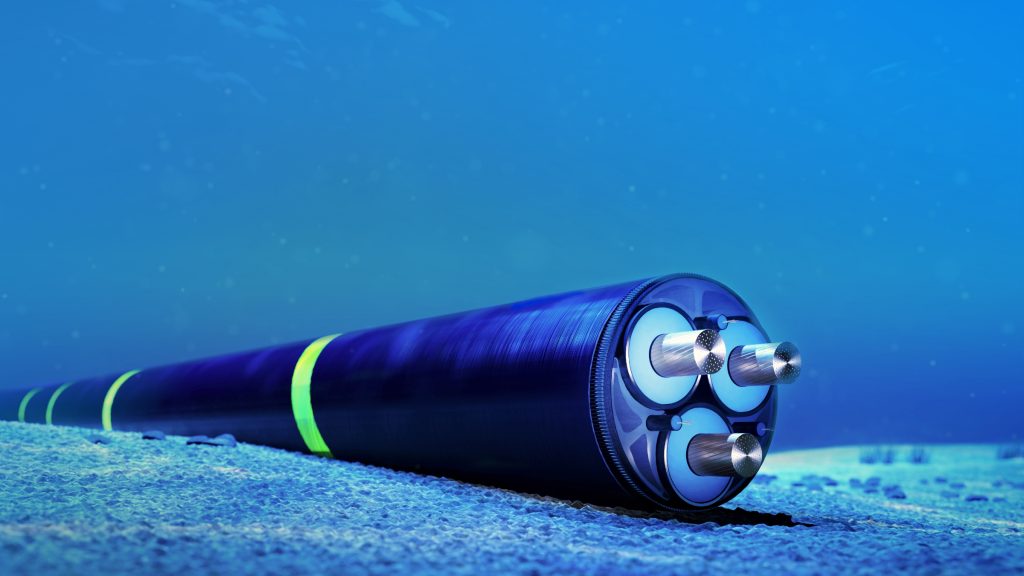
On July 21, Google launched its subsea fiber optic cable project in Lisbon, connecting Portugal and the US, through Bermuda and the Azores with 16 fibre pairs built to carry the increasing cloud and AI traffic across the Atlantic.
Physical internet is becoming central to the AI race, and companies are moving larger models between data centers. The Google subsea cable gives the cloud giant control over capacity, speed, and reliability across the Atlantic.
A Strategic Route for AI and Cloud Services
First announced in 2023, the Google Nuvem cable runs nearly 7,000 kilometers between Sines, on Portugal’s southwest coast, and Myrtle Beach, South Carolina, with branches to Bermuda and São Miguel.
The system uses 16 fibre pairs, each designed to carry about 24 terabits per second. Together, they give the subsea cable network a planned capacity of roughly 384 terabits per second, moving huge data volumes between regions.
The capacity matters because AI services require constant exchanges between computing centers. Training models, updating cloud applications, and delivering AI answers involve large transfers.
Google’s subsea fiber optic cable can support those workloads without relying fully on telecom operators.
Submarine cables form the hidden backbone of the internet, carrying calls, videos, messages, payments, and business data between countries. Each oceanic fiber optic cable runs along the seabed and can carry far more data than satellite systems.
The cables are protected by steel, copper, and other materials, but remain exposed to damage. Fishing activity, anchors, earthquakes, and undersea landslides can interrupt a subsea fiber optic route and force traffic onto alternative paths.
According to Google, Nuvem was created to improve network resilience in the Atlantic and help meet growing demand for digital services. By adding another subsea fiber optic cable, the company can redirect traffic when connections fail.
Instead of waiting for partners to approve capacity plans, the company can align the Google subsea cable with its own data centers, cloud regions, and AI platforms, delivering an advantage simply through ownership.
Portugal a Stronger Digital Gateway
Submarine routes are increasingly planned around data centers, energy access, and future computing demand, and Google’s decision reflects just that.
“Theoretically, we can build subsea cables anywhere,” said Nigel Bayliff, Google’s senior director for global submarine networks.
However, Bayliff explained that cables ultimately need to follow the locations where large data centers can access enough power and connectivity.
At the ceremony, Portuguese Minister, Gonçalo Matias, said the project would connect North America and Europe along a new digital corridor that crosses the Atlantic, believing the Google Nuvem cable does more than add another line by creating alternative routes.
Portugal’s western location makes it an attractive landing point. Sines face the Atlantic and provide access to the Americas, Africa, and Europe. The subsea cable network could encourage investment in data centers, cloud platforms, and technology services.
Portuguese telecom company MEO has joined the project as an investor and national partner, although it has not disclosed its contribution.
The subsea fiber optic cable strengthens Portugal’s position beside other major routes. Google’s Equiano system connects the country with Africa, while other infrastructure links Europe to South America, making Portugal an important meeting point for international data.
Nuvem Part of Google’s Strategy
Firmina links the US with South America, while Equiano runs from Portugal along Africa’s west coast. These Google subsea cables give the company several controlled paths across regions.
Google is also developing Sol, a separate system expected to connect the US, Bermuda, the Azores and Spain. Together, these projects will expand the Atlantic subsea cable network and provide more options when traffic must avoid a damaged route.
Industry leaders say AI is increasing demand for underwater infrastructure as older systems reach the end of their working lives. Building a subsea fiber optic cable, however, can take years because manufacturers, specialized ships, permits and landing stations are limited.
For Google, building a subsea fiber optic cable is not only about meeting today’s rise in internet traffic. It is about controlling more of the system behind its cloud and AI services, from data centers and software to the routes that move information between them.
That control can lower dependence on outside carriers, improve recovery during outages, and allow Google to expand capacity around its own business plans.
Nuvem also shows that the AI is moving beyond chips and data centers, as companies that control the networks connecting those facilities may gain an equally important advantage.
Inside Telecom provides you with an extensive list of content covering all aspects of the tech industry. Keep an eye on our Telecom sections to stay informed and up-to-date with our daily articles.