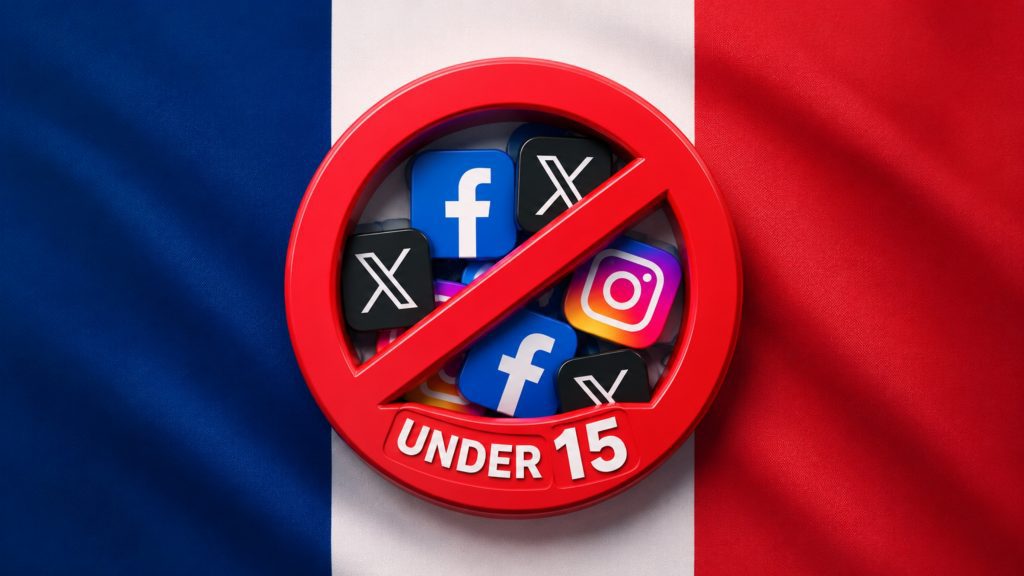
On July 21, the French parliament gave final approval to legislation of France social media ban, making it the first European Union (EU) member to categorically bar children under 15 from algorithmic social media platforms, TikTok, Snapchat, Instagram, and Facebook.
The vote was not close, with 279 to 81, effectively replacing three decades of voluntary platform self-regulation with prohibition enforced by the French state, backed by criminal accountability.
The France social media ban is the EU’s first nationwide restriction that forces social media platforms to verify users’ ages before granting account access.
The France social media ban turns child protection into a major technology test. Its success will depend on whether platforms can confirm a user’s age without collecting unnecessary identity data or creating security risks for millions of adults.
Networking Giants: Either You Abide, or You Abide.
From September 1, 2026, new account creation for under 15 years will be blocked, with all pre-existing accounts facing mandatory closure by January 2027. The rollout of the new age limits for social media is sequential and highly deliberate.
The timeline gives social media platforms five months to build the verifiable age-checking infrastructure the law requires and no mechanism to negotiate an extension from the French government.
The proposed EU social media ban approach also extends beyond account creation. France will prohibit mobile phones in high schools next year, adding to restrictions already applied in elementary and middle schools.
Supporters say the social media ban Europe debate is no longer only about screen time. It now focuses on recommendation systems, notifications, and endless feeds that can keep young users online for long periods.
“France is leading the way in Europe when it comes to protecting our children and teenagers,” said French President Emmanuel Macron, welcoming France social media ban.
Yet enforcing a ban on social media may be difficult. Teenagers could use virtual private networks, fake birth dates, or accounts created by older relatives to avoid automated checks.
Critics also question whether the age limit for social media can be enforced without asking users to upload passports, identity cards or biometric information, which could become valuable targets for hackers.
The European Commission believes technology can offer a safer path. Discussing the age limits for social media, Commission President Ursula von der Leyen described Europe’s age-verification app as easy to use, privacy preserving, and open source.
Europe Targets Platform Design
The wider EU social media ban discussion is linked to the Digital Services Act, which allows European regulators to challenge addictive designs, harmful content and online features that place children at risk. Von der Leyen said the social media ban Europe push should place responsibility on technology companies.
“The platforms were the architects of these systems, now they must prove that their services do no harm,” Von der Leyen said, highlighting that the France social media ban reflects a deeper question about platform power.
“It is about whether and when social media can access our children,” von der Leyen said.
Australia’s experience shows why the social media banned in countries trend remains controversial. After its under-16 restriction began in late 2025, many children reportedly continued using platforms bypassing age checks.
When France bans social media for younger teenagers, it may face the same weaknesses. Some users could move to smaller platforms with fewer safety controls, making harmful content harder for regulators and parents to track.
The social media ban Europe movement is also part of France’s digital sovereignty push, to reduce Europe’s dependence on large American and Chinese technology companies. For platforms, the latest France social media ban sends a message that age checks and safer algorithms are becoming legal duties rather than optional tools.
Inside Telecom provides you with an extensive list of content covering all aspects of the tech industry. Keep an eye on our Impact section to stay informed and up-to-date with our daily articles.
