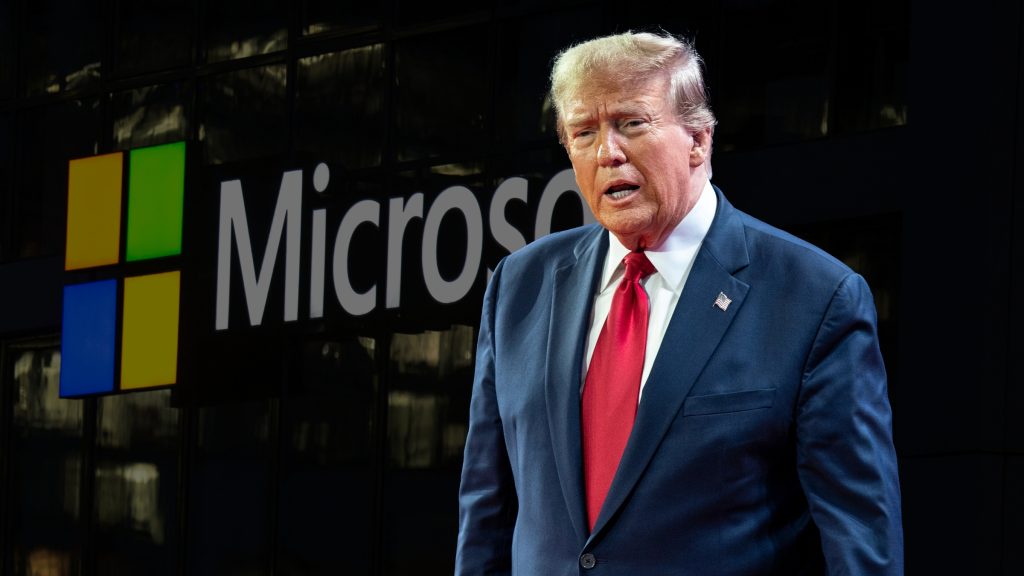
On Monday, President Trump announced on Truth Social that Microsoft will change its data center AI power consumption so it does not affect household electricity bills.
The AI infrastructure consumer cost and demand is straining power systems nationwide, with the technology behind AI developing in a fast pace, but energy systems supporting it are facing pressure.
AI Power Expanding Data Center Capacity to Meet Growing Demand
President Trump said on Truth Social that the administration is pressing large technology companies to shield households from higher bills linked to data center AI power consumption.
“I never want Americans to pay higher Electricity bills because of Data Centers,” President Trump wrote.
“Therefore, my Administration is working with major American Technology Companies to secure their commitment to the American People, and we will have much to announce in the coming weeks.”
The matter sits at the intersection of AI and electricity prices as utilities pass rising wholesale costs through to consumers. Trump chose Microsoft to act first to make major changes, ensuring that US citizens don’t pick up the tab for the Big Tech giant’s power consumption.
Microsoft did not immediately comment when requested by news outlets.
The software giant has publicly acknowledged the pressure created by its power hungry data centers and their role in local energy markets.
Tech companies, in general, argue these facilities are fundamental for global competition in AI, even as spending on infrastructure speeds up.
Digital Growth on the Expense of Americans
Across the US, consumers are feeling the repercussion weight of data center AI power consumption.
In Baltimore, 57-year-old Kevin Stanley, living on disability payments, said his power bills have risen by about 80% in the past three years alone.
According to Bloomberg News, a September 2025 report revealed that AI and electricity prices are closely linked near major server hubs. In other areas with heavy data center activity, wholesale electricity prices surged as much as 267% in a single month, compared to five years prior.
The fact of the matter is that most American citizens share regional grids, the AI demand and energy grid connection means costs can spread well beyond data center sites.
This has fueled debate over AI infrastructure consumer cost, especially for low-income households far from the technology boom. To respond, companies are exploring new energy sources.
Another Big Tech giant, Meta, recently signed deals tied to data center nuclear power, others have invested in efficiency to shrink the AI energy footprint of their operations. Microsoft has also scaled back on some projects, including a canceled Wisconsin site after local opposition.
Power hungry data centers are expanding across the US and will put policymakers in front of a difficult balance. Keeping the US competitive in AI while protecting consumers depends on managing infrastructure consumer cost and pushing toward an affordable energy transition.
Inside Telecom provides you with an extensive list of content covering all aspects of the tech industry. Keep an eye on our Intelligent Tech sections to stay informed and up-to-date with our daily articles.