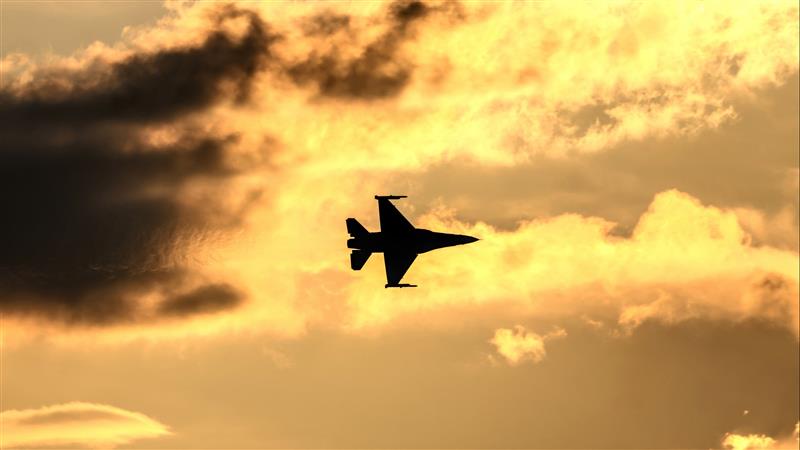
On December 11, the US authorized a $686 million upgrade for Pakistani F16 fighter jets, including modern avionics, navigation systems, and Link-16 communications, a move that could possibly be read with an intention to have full knowledge of Pakistani air activities and maybe pressure India.
The Pakistani F-16 will be equipped with new software and interoperability systems that will improve functionality but will also constrain direct links with Chinese air defense systems.
The F-16 advanced deal contains 92 Link-16 systems. This is an internal communications network that enables military planes and ground stations to communicate with each other.
Strategic US Pakistani F16 Upgrade
Although it will have benefits for better collaboration among members of the Pakistan Air Force, it will allow the US to monitor all uses of its cryptographic modules.
Praveen Donthi, senior analyst at the Brussels-based NGO ‘International Crisis Group,’ told Al-Jazeera that this F-16 to Pakistan upgrade allows the US to have a very detailed understanding of air operations conducted by Pakistan, including flight paths, communications, and mission planning.
“The F-16 deal remains a key part of the broader US-Pakistan bilateral relationship, which is why there has been continuity from President Biden to President Trump, despite some delays. Both sides emphasize the fleet’s utility in joint counterterrorism operations in the region,” Donthi said.
For analysts, these modules will be a constraint on the comprehensive integration of F-16s with Chinese fighter jets on issues relating to technological cooperation. The agreement will be seen as extending the life span of the Pakistani F-16 planes deployed and will be under US control.
Pakistan’s Military Power
During May, tensions between India and Pakistan escalated resulting in deadly attacks using high-end military technology, and the Pakistani F-16 was a key player in its fleet alongside purchased Chinese J-10C and JF-17 planes.
“In the fight with India, we used all our capabilities, including air, space, and cyber domains. It was a synergetic effect that a multi-domain operation was conducted. The JF-17, J-10C and PL-15 fighter jets and missiles played a critical role in achieving operational success,” said Pakistan’s Chairman Joint Chiefs of Staff Committee General Sahir Shamshad Mirza.
China remains Pakistan’s biggest weapons provider and donates highly advanced aircraft and weaponry. Recent exercises, such as the Warrior-IX counterterrorism drill, strengthened collaboration between the Pakistan Air Force jets fleet and Chinese units.
The US package also contains training and spare components for Pakistani F-16 pilot, enabling Pakistani air forces to remain fully operational. It represents an equal sign indicating that Pakistani airpower capabilities are boosted but that Washington retains a broader perspective on operations and prevents full Pakistani F16 cooperation with China.
The Pakistani fighter jets list includes F-16s, JF-17s, and Chinese J-10Cs.
“It’s largely a standalone deal. reflecting two separate tracks of security partnerships instead of a unified India strategy,” South Asia expert, Michael Kugelman said.
Did India Shot Down Pakistan F-16 in May?
Despite claims, India did not bring down any Pakistani F16 jets in May. Although some Indian officials reported that an aircraft had been shot down, it has been shown that these reports were wrong.
Pakistan forces maintained full accountability of its aircraft, and evidence eventually confirmed that no F-16 losses occurred during the clashes. This tricky situation became quickly part of a wider narrative battle.
Pakistan emphasized that the fact that F-16 Pakistan fleet could conduct operations in coordination with Chinese J-10C and JF-17 planes without any losses as proof of the growing readiness across the Pakistan fighter jets list.
India, however, emphasized air superiority projection through a mix of Rafales, Su-30MKIs, and domestically produced systems. This episode highlighted a very important dimension that information warfare travels along the pace of airpower.
As Pakistan expands its US and Chinese platform mix, ranging from Pakistan jets like the JF-17 to advanced J-10Cs, the narrative of who does what over the skies has emerged as an important tool for influence and deterrence.
But beyond political messaging, that technical reality remained clear back in May: no Pakistani F-16 had been shot down, and reports to the contrary have only since then been proved wrong.
The $686 million deal boosts the equipment of Pakistan air force upgrade. Enhancing radar, navigation, and combat capabilities of the Pakistani jets fleet.
By incorporating encrypted communications, the US ensures operations involving F-16 to Pakistan, effectively constraining Pakistan from fully integrating US and Chinese technologies. Moreover, it illustrates how modern military integrates technology, operational efficacy, and visionary control, as it enhances the Pakistani Air Force and keeps the Americans on board.
Inside Telecom provides you with an extensive list of content covering all aspects of the tech industry. Keep an eye on our Intelligent Tech sections to stay informed and up-to-date with our daily articles.