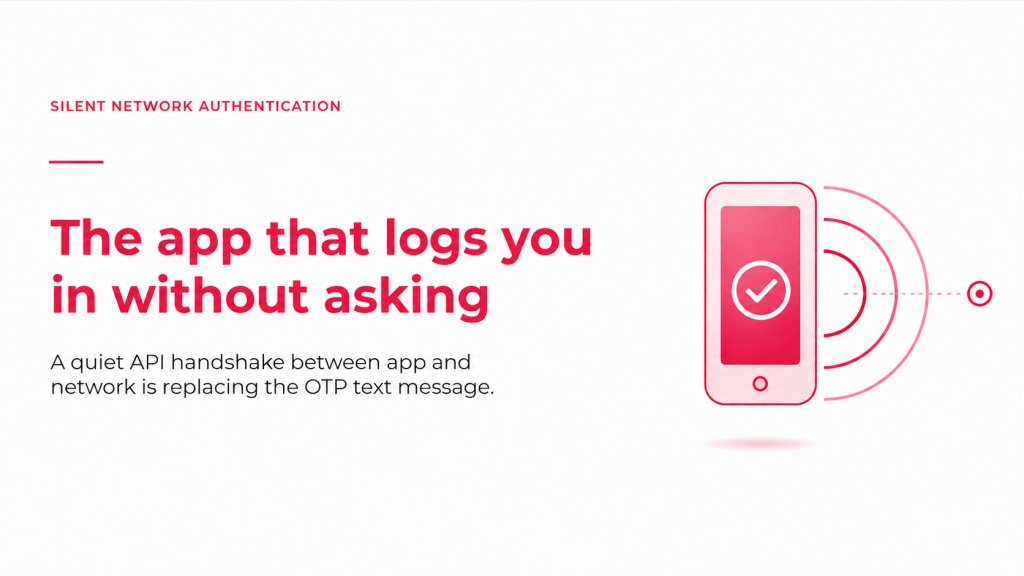
You open an app, and instead of a code landing in your SMS inbox, you’re just in. No typing, no waiting.
This is not a security gap. It is a design decision. This is Silent Network Authentication (SNA). It’s a quiet API handshake between the app and your mobile network. Understanding how that handshake works tells you a lot about where telecom is heading.
How It Actually Works
Every smartphone attached to a cellular network with an active data session is associated with a subscriber identity through SIM or eSIM and the operator’s core network. With the right APIs, the operator can correlate the network session with that subscriber identity and the associated MSISDN.
SNA uses that existing network context to verify a number without an OTP and without user interaction. The application sends a verification request through a network API exposed by the operator or by an API aggregator. The operator’s core functions process the request and check whether the requesting device session is associated with the MSISDN being verified. The network returns with a yes or no, and the user is verified without ever seeing the process.
The interface itself is being standardized. The CAMARA Number Verification API defines a network based mechanism for confirming the number allocated to the SIM in the device making the request. This is also adopted by GSMA Open Gateway.

What It Means for Telcos
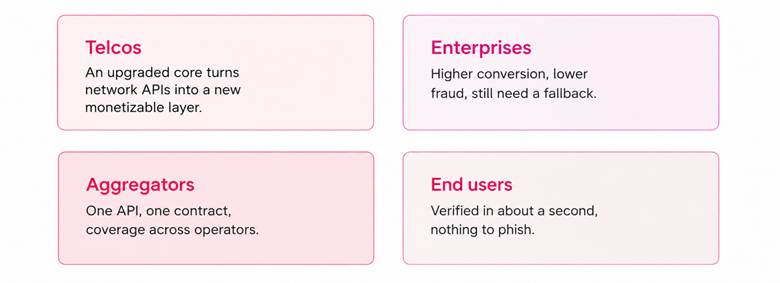
This is the part that gets skipped in most explainers. SNA and network APIs are not just authentication features for businesses. They are a new commercial relationship between mobile operators and the enterprises that need trusted access to network capability.
For decades, operators have monetized connectivity: voice, data, SMS. The question now is whether network APIs become the next billable and monetizable layer.
To take part, an operator needs a network API exposure layer wired into the core. In practice that means API gateways and management, security and identity handling, charging and settlement, and integration with NEF, UDM/HSS, PCF/PCRF and the relevant exposure interfaces.
It means investing in core infrastructure and gateways, setting a price per API call, and owning the verification flow end to end. It is not a switch operators flip. It is new infrastructure, with a new support model attached to it.
What It Means for Enterprises
For a bank, a fintech, a marketplace or a social media app, SNA is not a drop-in replacement for OTP. It changes the login flow itself. The app has to trigger the SNA check silently in the background, None of this is visible to the end user, but it is real engineering and QA work, not just a backend integration.
Get the flow right, and the advantages are significant: conversion goes up and fraud exposure goes down.
Enterprises still need a fallback path for Wi-Fi only sessions, uncovered operators, older devices and dual SIM handsets. In practice that fallback is still SMS OTP, SNA will be the primary path, not the only path.
What It Means for API Aggregators
This is where the model actually becomes usable. No enterprise wants to negotiate, integrate and test against dozens of individual operators one at a time, and no operator wants that many separate enterprise integrations.
Aggregators sit in the middle and provide one API, one contract and one set of connections across many networks. They act as the routing and billing gateway, handling every API request and response between operator and enterprise.
Monty Mobile sits on both sides of this. We run messaging and monetization infrastructure inside operator networks, and we deliver verification to enterprises through our own platform. That vantage point makes one thing clear: the aggregation layer will not be won on API design. It will be won on coverage, on how cleanly fallback is handled.
What It Means for End Users
The upside
The obvious win is customer experience. Cutting out the step where someone reads a code and types it back removes one of the biggest drop off points in signup and login. Verification completes in about a second, and the user never sees it happen.
The quieter win is safety. If there is no code, there is no code to be tricked into sharing. That closes off a large share of consumer fraud that relies on getting the victim to read something out loud.
The catch
For now it only works over mobile data, so anyone on Wi-Fi needs a fallback every time. Coverage is uneven by market and by operator.
The Next Questions
The technology is settled. The commercial model is not. The open questions are the ones operators and enterprises and aggregators should be asking in the same room:
- Who prices the call, and does the price hold once volume arrives?
- Which regulator owns consent when verification is invisible to the subscriber?
- Do the large app developers integrate directly, or only through aggregators?
- How is coverage reported honestly, so enterprises can plan a fallback rate instead of discovering one?
None of these are reasons to wait. They are reasons to be in the conversation early, because whoever answers them first sets the commercial norms for everyone else.
Monty Mobile has spent close to three decades on both sides of this exchange, working with operators on messaging security and monetization and with enterprises on verification. Network APIs are the same relationship, expressed through a different interface. The market is already asking what exposure costs, what it returns, and how quickly it can be deployed on top of what they run today. Those are the right questions.
About the Author
Razan Itani is the Technical Solution Director at Monty Mobile, where she leads the company’s anti-fraud products and operations. With over a decade in the telecom and monetization ecosystem, she brings deep expertise spanning the technical foundations of the industry to the market challenges shaping it. Connect with her on LinkedIn.
Inside Telecom provides you with an extensive list of content covering all aspects of the tech industry. Keep an eye on our Telecom sections to stay informed and up-to-date with our daily articles.
