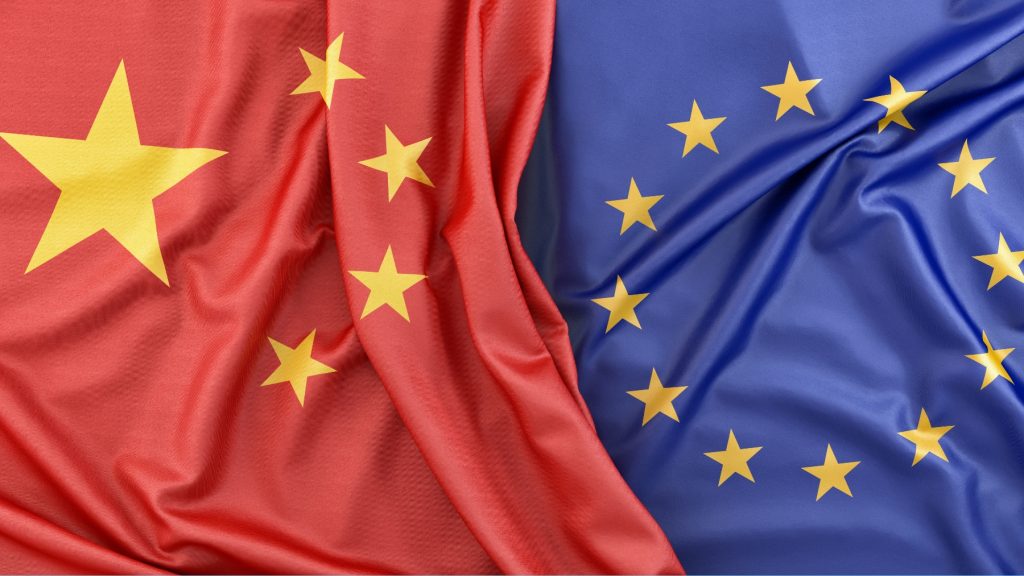
On October 8, EU trade chief Maroš Šefčovič will travel to Beijing for two days of talks that Brussels hopes will head off an EU China trade war, with fresh data showing Chinese hybrid cars – a category outside the EU’s electric cars (EV) tariffs – taking a growing share of the European market.
The EU official will be seeking protection for European industries while maintaining access to Chinese materials that support car production, semiconductor manufacturing, and clean energy supply chains.Europe wants fairer competition, but restrictions could hurt manufacturers using Chinese inputs.
Trade commissioner Maroš Šefčovič, and Chinese counterpart Wang Wentao, are due to meet on October 8 and 9. Negotiations since June have focused on EU trade deficit with China, rising exports, and access to critical supplies.
The EU wants to cut that deficit, expand its own exports to China, and secure an export-licensing system for rare earths and other products, after China imposed restrictions on rare earths last, according to AFP.
In the summer, Šefčovič demanded “tangible results by October.”
Hybrid Cars Test Europe’s Trade Defenses
The EU China trade war discussions will tackle the Chinese competition that’s moving into advanced manufacturing. European officials see risks for industries already facing pressure to modernize, while Beijing depends on exports to support growth amid weak domestic demand.
Brussels wants to reduce import surges, expand European exports to China and secure predictable licensing for rare earths and other restricted products.
The China EU trade war risk also exposes disagreements over how far Europe should go. China opposes import quotas, while European officials want voluntary limits on hybrid cars and potentially other products.
Economist professor at the China Europe International Business School in Shanghai, Zhu Tian, expects a limited outcome. Professor Tian believes talks could yield “agreements on some specific issues, rather than any broad settlement.”
In parallel, the EU Commission is working on new trade-defense tools, to be presented to EU leaders in December. On its own, that can be perceived as an indicator that Brussles does not expect the talks to resolve the concerns.
“There may be a few crumbs, but I would not expect any kind of major breakthrough,” said director of the Brussels office of the German Marshall Fund of the US, Penny Naas.
The EU and China trade war discussions may deliver limited agreements rather than a broad settlement. The dispute over Chinese EU tariffs extends beyond cars. Machinery, metals, chemicals, and textiles also face unusually strong import growth, according to European trade officials.
Why Chinese Hybrid Cars Center the EU-Beijing Talks
In 2024, the EU imposed anti-subsidy tariffs on Chinese battery-electric cars with duties reaching up to 45%. EVs from China face additional anti-subsidy duties introduced in 2024, while hybrids fall outside those measures and tariffs don’t cover hybrids.
According to The Guardian, Eurostat data shows Chinese-made plug-in hybrid sales in the EU rose from 56,706 in 2022 to 217,764 in the first seven months of 2026. Sales from hybrid Chinese cars in EU rose from 659 in 2022 to 160,662 over the same seven months.
So which Chinese EV/hybrid cars brands are growing the fastest in the EU market?
Geely, which also owns Volvo and Polestar, remains the crown bearer of the top Chinese brand in the EU with 205,000 cars sold in the first eight months of 2026, up 8%. BYD sold 177,000 vehicles in the same period, up 163%.
Chery and Leapmotor are all posting triple-digit growth. Hybrids now make up almost 37% of the EU car market and battery-electric car just over 21%, according to the European Automobile Manufacturers’ Association (ACEA).
According to The Guardian, the EU imports three times more from China than it exports there.
Europe’s trade deficit with China reached about $403.38 billion (€360 billion) in 2025. Beijing reports a lower figure but also expects the imbalance to increase.
The gap complicates Europe China tariffs policy as manufacturers can compete through cars combining fuel engines with electric power. Fully hybrid models generate electricity internally, while plug-in hybrids can also charge externally.
The EU China EV trade war therefore does not cover every competing vehicle. Hybrid imports have become a separate concern, prompting discussions about safeguards.
Manufacturers of Chinese EV in EU markets must distinguish fully electric models from hybrids. Their different treatment means existing duties cannot address every import surge.
What Brussels’ Asking from Chinese Hybrid Exports
The EU has asked China to limit hybrid exports voluntarily, or face safeguards. An EU official said Brussels is willing to extend such limits to other products.
Responding, Beijing said it firmly opposes import quotas, according to AFP.
EU trade enforcement chief, Denis Redonnet, has named machinery, textiles, basic metals, and chemicals as sectors facing unusually large and persistent import increases. European leaders describe the trend as “China Shock 2.0” – as in Chinese companies are moving into high-tech manufacturing that threatens established EU industries.
For EU China EU EV tariff negotiations, that distinction matters: officials must decide whether separate measures are justified, rather than assume electric-car duties cover hybrids.
The EU China trade war could raise prices if duties increase import costs or quotas restrict supply. These are possible effects, not price increases established by the reports.
Measures affecting Chinese cars in EU markets could give European producers breathing space. Yet fewer affordable alternatives could make replacing a car more expensive for households.
EU Stance on US China Trade War
Europe’s position towards the US and China involves protecting its own industries while avoiding supply disruption. France and other member countries want a European trade tool comparable to the American Section 301 mechanism.
The US China trade war impact on EU manufacturers depends partly on access to Chinese supplies. Europe’s proposed response borrows from American enforcement methods but must account for its own industrial exposure.
Beijing has warned it would “respond resolutely” to restrictive measures, making the China EU trade war a question of production security as well as market competition.
The EU China trade war threatens an uncomfortable balance, where Europe wants less dependence on China while still needing materials supplied through Chinese networks.
Europe has heavy reliance on clean energy, EV, semiconductors and defense, including rare earth magnets and battery materials. However, its report does not provide one dependency figure covering all these sectors.
Export restrictions can leave factories waiting for essential inputs. If shortages interrupt production, technology products could become more expensive and manufacturing jobs could face pressure, although the sources do not quantify those outcomes.
Further Europe China tariffs would not automatically create alternative suppliers. Europe needs investment in sourcing and production alongside trade protection.
The Commission’s proposed approach would limit purchases of a critical component from one supplier to 30–40%. Companies would need two or three sources from different countries.
The commissionalso reports a $3.36 billion (€3 billion) ReSourceEU plan supporting alternative supplies. Separately, the main report describes further funding tools being developed to help businesses diversify.
Reducing dependence is possible, but replacing established suppliers requires money and time. Critics warn compulsory diversification could raise costs, weaken competitiveness, and create problems under World Trade Organization rules.
Germany’s caution shows why agreement remains difficult. Its close trading relationship with China leaves exporters exposed, even as concerns about Chinese industrial overcapacity strengthen calls for action to protect domestic production.
Country neutral legislation and gradual investment could help manage those risks. Neither negotiations nor tariffs alone can guarantee cheaper supplies or secure jobs.
The final EU China trade war test is whether Europe can defend manufacturers without cutting their access to essential materials. Beijing talks could ease immediate tensions, but lasting protection depends on affordable alternatives and reliable supply agreements.
Inside Telecom provides you with an extensive list of content covering all aspects of the tech industry. Keep an eye on our Tech sections to stay informed and up-to-date with our daily articles.
