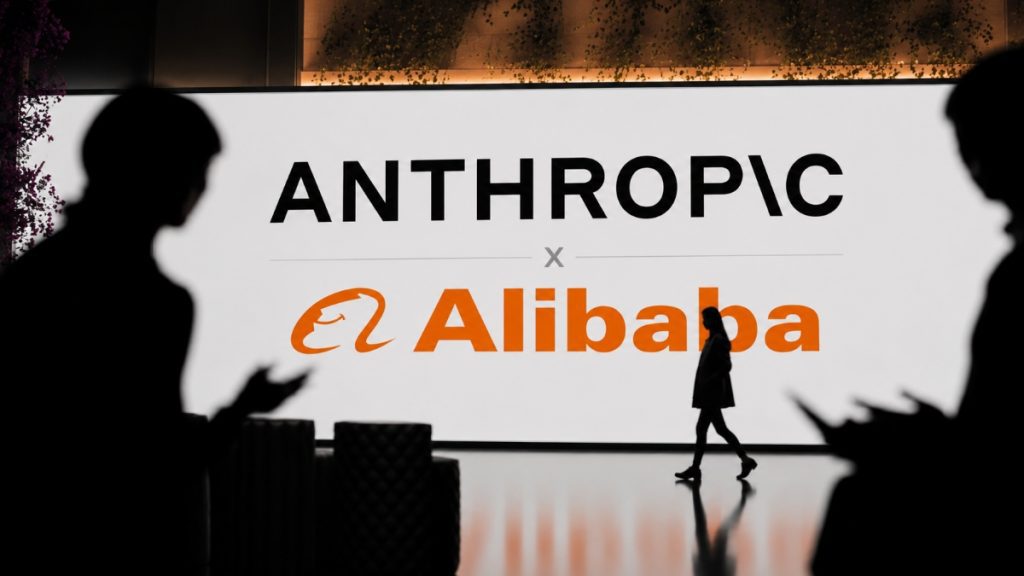
Ahead of Anthropic’s expected AI IPO later this year, its fight with Alibaba is becoming a test of whether frontier AI, stock markets, and national security can still move freely as US and Chinese tech capital splits into rival lanes, according to Fortune.
The dispute lands as China pushes chip, robotics, and AI companies toward onshore IPO, while SpaceX blocks Chinese and Hong Kong investors from its Wall Street debut. Together, the stories point to one shift, strategic technologies are no longer only competing for users. They are competing for protected capital and safer markets.
AI Becoming a Market Risk
Anthropic has accused Alibaba of finding a cheaper path into its own advanced AI IPO, not by stealing servers or smuggling chips, but by using fake accounts and simple interactions with Claude to extract its capabilities and train rival systems.
That allegation matters because Anthropic is preparing for one of the most watched AI IPO. If investors see Claude as a strategic US asset in the technology race with China, the dispute could strengthen Anthropic’s story. But if they see distillation as proof that frontier AI can be copied faster than it can be defended, the same story could weaken future profits.
Leading IPO expert Jay Ritter told Fortune that both views are possible, but profitability may matter more.
“Both points of view have merit, but I think that second point about affecting profitability would be the dominant one,” he said. “Right now the growth rate of Anthropic’s revenue has been incredible, but how much they’ll be able to sustain that is a big question mark.”
Anthropic can sell itself as a national asset, but public investors will ask whether its moat can survive cheaper Chinese models trained through alleged distillation.
In frontier AI, the original model may carry trust, safety, and enterprise confidence, yet the cheaper copy changes the pricing story.
Anthropic is now asking Washington for help. Anthropic’s head of policy, Sarah Heck, urged Congress to punish China’s behavior through “export controls on advanced American compute.” But export controls were built for hardware, chips, and tangible software access. They are weaker when the alleged problem is model behavior learned through an API.
Former assistant secretary of commerce for export administration, Kevin Wolf, put it clearly, “Querying it through an API is not exporting the model, and that’s what the latest controversy has been about.”
That loophole is why the Remote Access Security Act is back in the conversation. The bill would target foreign access to sensitive US technology when access could pose national security risks. For Anthropic, the law could offer protection. For investors, it could show the business now depends on Washington as much as engineering.
Capital Splits Along Security Lines
While Anthropic looks for stronger US protection, China is building another route.According to LSEG data, Chinese technology companies raised $3.1 billion from stock offerings in the first half of the year, sharply above the previous year’s figures.
Nearly 50 companies have filed AI IPO applications in Shanghai and Shenzhen. Together, they aim to raise at least 126.1 billion yuan, or $18.7 billion. ChangXin Memory Technologies is planning a 29.5 billion yuan offering, the largest of the year.
This is not only a market rebound. It is a policy signal. China wants its capital markets to fund companies that can reduce dependence on US chips, models, and platforms. New Shanghai Stock Exchange rules to support large language model (LLM) companies on the STAR Market make that clearer.
At the same time, US linked giants are narrowing investor pools. SpaceX, preparing for what reports describe as the biggest onshore IPO in history, has blocked Chinese and Hong Kong investors from buying shares. The company points to national security and US International Traffic in Arms Regulations, which govern sensitive aerospace and defense technology.
“As far as I can recall, this is one of the first times an entire nation has been so explicitly excluded from an initial public offering,” said Grégoire Kounowski, an investment adviser at the Norman K group advisory firm.
SpaceX may not need Chinese money because demand exceeds supply. But the move still matters. It shows that strategic IPOs may not chase every investor. They may choose political safety over maximum global access.
That could shape OpenAI and Anthropic next. If aerospace, AI, chips, and cloud compute are treated as security assets, then capital will follow borders more than opportunity.
Anthropic’s Alibaba fight, China’s onshore AI IPO push, and SpaceX’s investor ban all point to the same future, technology capital is less global, more political, and divided between systems that trust each other less over time.
Inside Telecom provides you with an extensive list of content covering all aspects of the tech industry. Keep an eye on our Intelligent Tech sections to stay informed and up-to-date with our daily articles.
