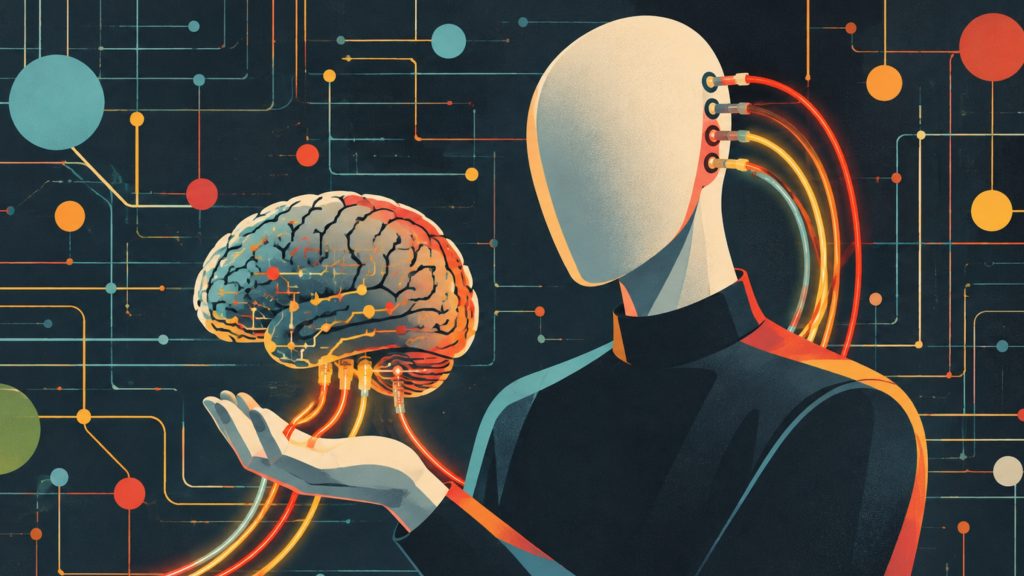
On October 1, Cognition published “AI is not as conscious as humans: Essentialism in mental state attributions to artificial systems,” finding that people distinguish human-like AI behavior from consciousness, despite comparisons describing modern AI technology as a mechanical brain.
Michael Hout and Arryn Robbins traced modern AI to efforts to understand human learning. Their arguments put a practical problem before users, so chatbots can produce convincing answers without retrieving verified facts.
AI Learned from the Study of Minds
The term “artificial intelligence” was coined at the 1956 Dartmouth College workshop, where researchers explored whether written rules could make machines intelligent. In 1958, psychologist Frank Rosenblatt took a different route, developing the Perceptron to learn from examples.
That shift helps explain why AI cognitive architecture draws on ideas about learning rather than simply storing answers. Rosenblatt’s neural network loosely borrowed from the brain’s organization, building on earlier work about connections between neurons.
Later, David Rumelhart, Geoffrey Hinton, and Ronald Williams developed methods for training multilayer neural networks. Advances in computing, graphics, chips, and transformer models helped turn those foundations into today’s conversational systems.
Yet calling this technology a mechanical brain requires care, as the comparison explains aspects of its behavior without establishing that machines think or experience the world as people do.
“Modern AI isn’t born from rules—it’s grown from examples,” wrote Hout and Robbins.
For users, that distinction changes what critical thinking bot can reasonably promise. A fluent response may reflect learned patterns, while its factual claims still require checking.
The authors compare AI’s invented answers with human memory, which reconstructs information and can fill gaps inaccurately. This makes AI cognitive ability a question of performance and reliability, rather than an assurance that every answer comes from a dependable record.
A mechanical brain can therefore offer different responses to similar questions. Wording and context influence outputs, making confidence a poor substitute for evidence.
When AI cognitive automation enters everyday work, an employee may mistake generated text for verified information. An error, then, can travel from a draft into a report or decision.
Describing a chatbot as a brain AI extension may suggest a useful assistant, but users still need to distinguish help with writing from independent confirmation of facts.
Similarly, AI cognitive adaptation should be assessed through observable changes in performance. A response that fits a conversation does not establish human understanding.
For organizations exploring AI cognitive automation, the practical question becomes how outputs are reviewed. Speed offers limited value when users cannot identify which claims need further investigation.
Humanlike Responses Leave Consciousness Unresolved
The supporting research, led by Louis Longin at Ludwig Maximilian University of Munich, examined nearly 1,100 participants. They read scenarios featuring artificial agents or humans reacting to their surroundings, then rated consciousness or awareness.
Greater responsiveness raised both ratings. However, even the most responsive artificial agent received lower consciousness ratings than the least responsive human. The gap was much smaller for awareness, according to SciTechDaily.
“We may be using mental terms to refer to AI, but this may only be because we lack better words,” said senior author Ophelia Deroy.
The findings concern public judgments, rather than proof of whether a mechanical brain has subjective experience. They also show why language deserves attention when describing technology.
An AI cognitive agent may respond appropriately to an event, yet that behavior alone cannot settle what, if anything, it experiences.
Claims about AI cognitive abilities therefore need clear definitions. Recognizing information, producing language and experiencing consciousness are different questions, even when descriptions blur their boundaries every day.
For developers, explaining AI cognitive architecture should help users understand how a system operates and where uncertainty remains. Human comparisons become less useful when they encourage assumptions that testing has not been established.
The same applies to critical thinking bot marketed as a partner in judgment. Users need evidence that it can handle the task, including cases where its reasoning fails.
Meanwhile, current research into AI neural architecture includes efforts to inspect models internally. Hout and Robbins describe this work as an exchange between computer science and cognitive science, with each field offering tools for understanding intelligence.
Assessing AI cognitive ability consequently requires more than judging how natural an answer sound. The relevant test is whether performance holds up under scrutiny, especially when a plausible response contains mistakes.
That means asking what evidence supports an answer, who checks it, and how mistakes are corrected before relying on it.
A mechanical brain remains in comparison with limitations. For readers, workers and educators, understanding those limits offer a stronger basis for trust than treating an articulate chatbot as either a perfect reference source or a human mind.
Inside Telecom provides you with an extensive list of content covering all aspects of the tech industry. Keep an eye on our Intelligent Tech sections to stay informed and up-to-date with our daily articles.
