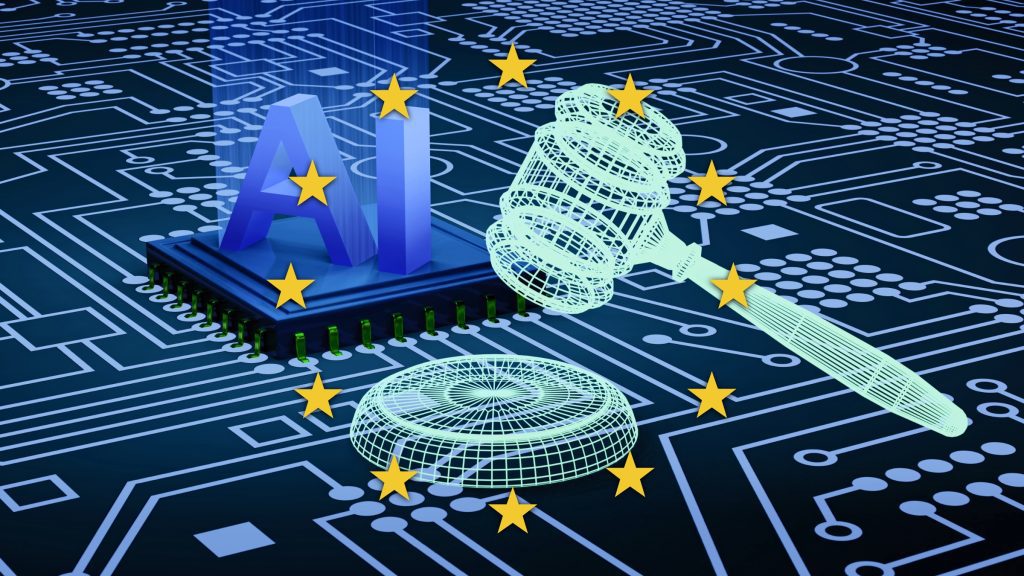
On Thursday, the European Union (EU) lawmakers reached a political agreement after nine-hour overnight negotiations, with a compromise that managed to retreat and advance simultaneously. A political EU AI Act news that satisfied neither purists nor pragmatists entirely.
In Brussels, this typically means that the deal will hold.
The agreement, reached in the early hours between the Parliament, Council, and Commission in what negotiators bestowed as an Omnibus session, extends the compliance deadline for the European Union AI Act most consequential provisions by up to 16 months.
The European Union AI Act has moved into its next implementation stage. Even though the initial European AI Act was considered one of the best examples of legislation around the globe concerning the issue of safety, the process of actual implementation of these laws turned out to be very difficult for local companies.
High-risk AI systems governed by Annex III – applications used in hiring decisions, credit assessments, and law enforcement – will be exempt from the mandatory compliance requirements until December 2, 2027.
It’s a worthy reprieve from the August 2026 deadline that had been generating quiet alarm across European boardrooms.
At its core, the EU Omnibus simplification package acts as a technical reset, designed to merge overlapping regulations and reduce administrative costs that were projected to reach billions.
By pausing it, the EU is trying to breathe life into its technology sector, making sure that the regional companies will not suffer from excessive bureaucracy before being able to establish themselves.
Accordingly, balance is attained as giving local companies the space and time to grow while keeping the door open for global tech giants to further strengthen their influence.
The EU Omnibus directive update is a response to competitive pressure that has become impossible for Brussels to ignore.
With American and Asian AI developers operating under no equivalent compliance burden, European companies have been warning for a while now, with increasing urgency, that the original timelines would function less as a regulation than as a structural handicap.
The old deadline imposed audit costs, documentation requirements, and legal exposure on EU operators that their US counterparts would not face for years – if ever.
A Second Opportunity for AI under EU Omnibus Directive
One of the most important aspects of the EU AI Act news that stands out is the change in the schedule. This is because for all AI systems classified as high-risk -those that operate in sectors such as education and employment – the new deadline is now December 2, 2027.
This EU AI Act news today update provides much-needed breathing room for developers. For AI embedded in physical products like toys or elevators, the wait extends to August 2028.
The delay is a pragmatic response to a difficult truth: the infrastructure needed to enforce the AI Act EU regulation simply wasn’t ready.
“The current state is that companies are confused about whether they should follow the AI act or sectoral legislation,” explained Arba Kokalari, the rapporteur for the European Parliament’s Internal Market committee.
“Companies should not be regulated twice for one thing,” Kokalari added.
By aligning the rules via the EU digital Omnibus, the union is trying to cut through the ‘double regulation’ that many feared would stifle local inventors. To further support this, the agreement introduces regulatory sandboxes to let them test products before they enter the market.
It is a move designed to keep the ‘Made in Europe’ tag competitive in a race currently dominated by US companies.
Sovereignty vs. Speed in the Digital Omnibus EU AI Act
While the EU AI Act news update is a win for business owners, it does question Europe’s own digital independence. By delaying these protections through the EU digital Omnibus, they are essentially allowing a longer period where foreign AI models can operate with fewer restrictions.
Therefore, a sovereignty gap is created, where the rules intended to protect European values are sidelined to allow the market to keep moving.
Critics argue that this EU AI Act news today development might actually increase Europe’s dependency on external technology. If local firms spend the next two years just trying to understand the EU Omnibus directive, they may continue to rely on pre-existing tools built by large-scale providers from outside the bloc.
However, the EU AI Act news remains firm that certain lines cannot be crossed, regardless of the timeline established by the EU digital Omnibus. The agreement includes a strict ban on nudification apps – AI tools used to create non-consensual sexually explicit content.
The ban is set to take effect much sooner, by February 2027.
“We wanted to have clarity on what we think about [nudification apps] in Europe and that we are not accepting of it,” said Arba Kokalari, the rapporteur for the European Parliament’s Internal Market committee.
Renew Europe lawmaker Michael McNamara added that these rules are targeted at protecting real people, applying to any AI-generated content where a person’s intimate parts are exposed without their permission.
Ultimately, the EU AI Act news today and 2027 delay is a calculated gamble. The EU AI Act news is the combination of looser deadlines for enterprise compliance and harder prohibitions on consumer-facing abuse.
The Commission’s attempting to make the EU AI Act as a pro-innovation and pro-protection initiative, simultaneously. Whether the market reads it in the same tone as the Commission, or nothing but a mere delay, may depend on what the next 16 months produce.
Inside Telecom provides you with an extensive list of content covering all aspects of the tech industry. Keep an eye on our Tech sections to stay informed and up-to-date with our daily articles.