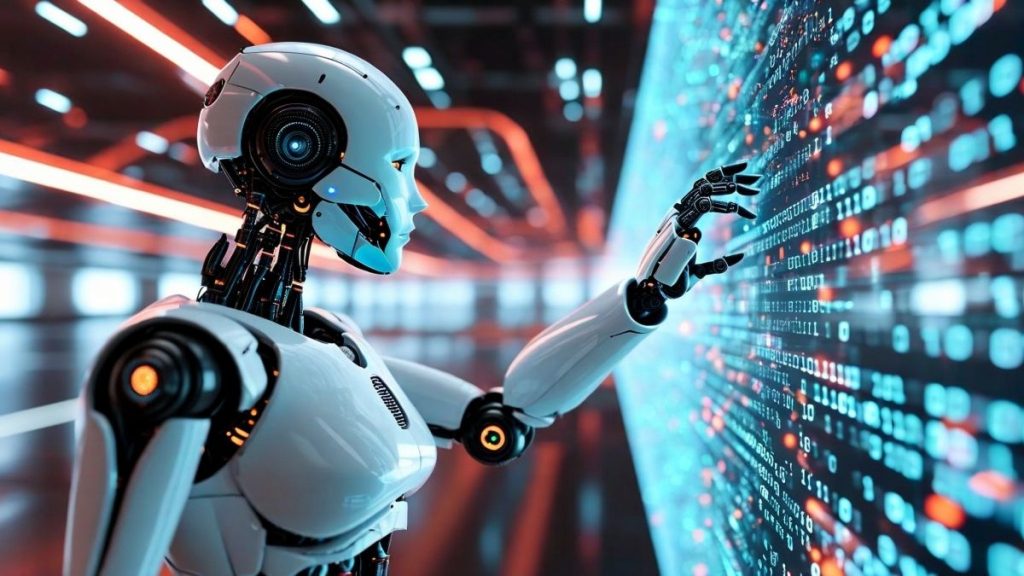
On October 1, Germany’s VDMA engineering association called on Berlin and Europe to build domestic supply chains for humanoid robots Europe components, saying the sector should be a top a political priority, as China’s Unitree listing highlighted how quickly global competition in robotics is scaling production worldwide.
China build nearly every humanoid robot sold today, a but a new industry study argues Germany’s path into the sector runs not through building finished robots, but through supplying the specialized joints, hands, and gearboxes that go inside them.
These are the same components German automotive suppliers have manufactured for decades.
Europe is fighting to find its place in a humanoid robot market shaped by China. Its manufacturing strength in motors, gearboxes, sensors, and precision parts could secure a larger role in physical AI.
What the Fraunhofer Study Found
The Fraunhofer Institute for Manufacturing Engineering and Automation’s (IPA) report, in partnership with consultancy P3, established that the strongest Germany humanoid robot opportunity is in existing automotive supply chain, and not in building complete robots domestically.
“In principle, the potential along the German and European supply chain is very large,” said Vincent Bezold, head of IPA’s Automated Manufacturing Systems business segment, who authored the report.
IPA estimates that the humanoid-robot components market will be worth approximately $30 billion by 2030.
Why Germany Needs to Build Components, Not Finished Robots
A conventional industrial robot needs seven joints. A humanoid robot needs more than 40, each needing a motor, gearbox, bearing, and sensor. These are elements Europe has spent decades manufacturing.
Several robotics companies in Europe already produce key mechanical parts. Others, German and European automotive suppliers, including Schaeffler, Bosch and Schunk, already mass produce priestly these components for the car industry.
According to Bezold, this existing industrial base gives the first Germany human robots market entry, even without a strong domestic robot-manufacturing sector of its own.
A Europe humanoid robot does not need to be built entirely by one company for the bloc to benefit.
Germany Scaling Against China’s Robotic Market Lead
In the first half of 2026, China accounted for the 97% of the 19,100 humanoid robots delivered globally, according to research firm, Smart Analytics Global (SAG).
Chinese manufacturers dominated these deliveries, but for the humanoid robots Europe market to thrive, or merely enter the race, the issue lies in whether European suppliers can enter the value chain before production networks become harder to change.
Chinese company, Agibot, alone delivered 8,400 unites, while US-based manufacturers such as Elon Musk’s Tesla, Figure AI, and Agility Robotics trail behind.
SAG projects around 60,000 units will ship globally by end of 2026, rising to half a million by 2030. Despite the shipment volume, SAG cautions the technology remains pre-commercial, leaving the door open a possibility for a Germany human robots market entry, as suppliers have relevant production skills.
The leap from robots that can perform for demonstrations to robots that work reliably in production has not yet been made.
German robot companies can grow as humanoids move from demonstrations into factories. Industrial customers need machines that repeat tasks safely, making durability as important as advanced AI.
Evidence of German Suppliers Entering Robotics Sector
In August 2026, Schaeffler revealed a new strain-wave gear – a high-precision gearbox – developed specifically for humanoid robot joints.
According to the motion technology manufacturer, a new production method cuts manufacturing costs by more than 25%, and reduces material consumption by 75%, with series production targeted for mid-2027.
“The re-shaped strain wave gear is another example of how we are industrially advancing core robotics components and preparing them for high-volume series production,” said David Kehr, Schaeffler’s President of Humanoid Robotics.
Schaeffler received Hannover Messes 2026’s Hermes Award for its humanoid robot joint actuators, which the German manufacturer says account for around 50% of humanoid robot’s total cost.
Since June, Bosch and Schunk have jointly developed a robot hand designed to integrate across multiple humanoid robot platforms, combining Schunk’s two decades of gripping-technology expertise with Bosch’s precision mechanics, electronics, and planned series manufacturing.
“Robots hands are a key component in advancing humanoid robotics in production and enabling more flexible and precise work than with conventional gripping systems,” said Mathias Pillin, Chief Technology Officer (CTO) at Robert Bosch GmbH.
Scaling Humanoid Robots Becomes Europe’s Real Test
According to VDMA, humanoid robots Europe should become a political priority because the main challenge is scaling production. Europe needs investment, factories and customers that can turn strong engineering into products available at competitive prices.
The Europe robot sensor market could benefit as machines need better awareness of force, balance and movement. Sensors will be central to safe industrial work, but suppliers need parts that are durable and easy to integrate.
The Germany humanoid robot opportunity extends to hands. Bosch and Schunk are developing a robot hand for several humanoid platforms, combining gripping technology with electronics, software and precision mechanics.
Still, humanoid robots Europe faces a wider problem. Europe could supply valuable hardware while Chinese or US companies control robot platforms, AI software and customer relationships, leaving European firms with less influence.
A stronger Europe robot strategy would connect manufacturers, research centers, startups and users earlier. The aim is to make European components part of future standards instead of adapting to designs created elsewhere.
For robotics companies in Europe, access to robot makers will be critical. Fraunhofer warned that supply chains usually form around final manufacturers, meaning Europe could lose opportunities if most production stays overseas.
Therefore, the Germany human robots market depends on timing as much as engineering. China has production scale, while US firms are investing heavily in AI and robotics.
Europe’s advantage is industrial knowledge, and a second Europe humanoid robot path is clear.
Build more complete machines locally while supplying joints, hands, drives and sensors globally. So, if humanoid robots Europe becomes an industrial strength, Europe will need to structure both robots and the supply chains behind them.
Inside Telecom provides you with an extensive list of content covering all aspects of the tech industry. Keep an eye on our Intelligent Tech sections to stay informed and up-to-date with our daily articles.
