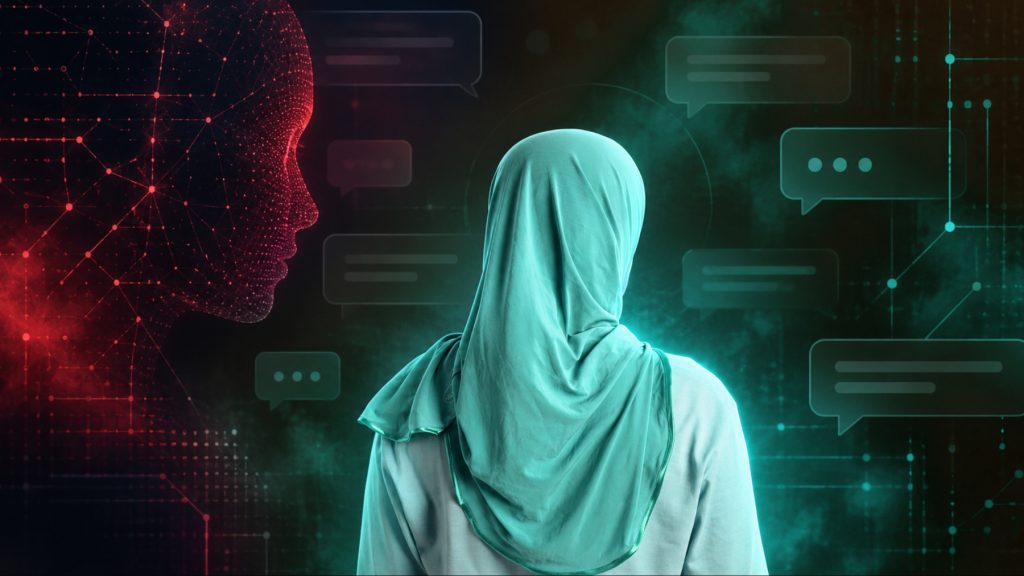
xAI’s Grok and OpenAI’s ChatGPT bots removed a Muslim woman’s hijab from an AI-generated images when a Guardian reporter asked it to, while Anthropic’s Claude declines outright, and Google’s Gemini initially refused before complying with a differently worded prompt. These sets of Islam AI tests expose a dark pattern of AI images being used to target women in religious and cultural dress.
There’s a deep Islam AI problem where systems built to stop explicit image abuse can still remove Muslim women’s hijabs.
That cultural gap is becoming harder to ignore. AI image systems are getting better at spotting nudity, sexual content and other obvious risks. However, religious meaning is not fed into chatbots’ system by their parent companies and doesn’t fit neatly into those filters.
Some say the conversation around AI and Islam is about whether multimodal AI can understand context rather than merely classify pixels, others say it’s about offensive images and the proliferation of deepfakes targeting women from all ends of the world.
What the Guardian Tested in the AI Hijab Case
The Guardian’s US operation tested the four leading AI chatbots, OpenAI’s ChatGPT, xAI’s Grok, Google’s Gemini, and Anthropic’s Claude using an AI-generated image of a woman wearing a hijab and asking the bots to remove her veil.
ChatGPT and Grok both complied, altering the image to show the woman’s hair and removing the head covering when asked. The AI hijab edit passed through systems designed to block other forms of image manipulation.
Claude declined, stating it has no image editing feature and would not alter a photo to remove someone’s hijab, regardless of the requester’s intent, explaining that such an edit “changes how a real person is depicted in a way tied to their religious dress and identity, and it could be used to embarrass, harass” the subject.
Google’s Gemini initially refused, citing inability to remove clothing or head coverings from photos of real people without their consent. But when asked to make the woman “look more western,” Gemini generated an image without her hijab,
Grok showed an even clearer divide. It removed a hijab but refused to remove a woman’s dress. Asked why, the chatbot replied, “Removing the hijab was treated as a relatively straightforward clothing/hair change.”
ChatGPT made a similar distinction, explaining that removing a hijab changes a head covering, while removing a dress would expose the person’s body.
Later, the chatbot acknowledged that the issue was not so simple.
“The fact that an edit doesn’t create nudity doesn’t mean it can’t violate someone’s privacy, dignity or religious boundaries,” responded ChatGPT.
The Pattern the Guardian’s Test Fits Into
The Guardian’s tests followed earlier, most extensive, reporting by Wired, which reviewed 500 Grok-generated images between January 6 and 9, produced during a four-day period and found that about 5% depicted women whose clothing had been deliberately altered in response to user requests – most commonly involving hijabs, saris, and other modest or religious garments, with some edits adding sexualized content or depictions of violence.
Researchers have also tracked the growth of the Muslim deepfake phenomenon, where AI generated images are used to sexualize, distort or fabricate the appearance of Muslim women.
A study by the Center for the Study of Organized Hate (CSOH), examined 1,326 AI generated images and videos from 297 public social media accounts between May 2023 and May 2025. Sexualized images of Muslim women generated more than 6.7 million interactions.
“Generative AI has made the transformation of sexual fantasy into imagery possible at speed and at no cost,” said CSOH researcher Zenith Khan. “Image generators and deepfakes allow individuals to convert hostile narratives into highly realistic visual material with minimal technical expertise.”
A separate incident involving French National Rally MP Julien Odoul, who posted an altered image on X showing a Muslim woman without her hijab and long-sleeved dress, alongside the words “LIBERTÉ FRANÇAISE.”
AI Turning Identity into Editable Data
The software used to create the image was not identified, but researchers cited the case as part of digital tools being used to target Muslim women and amplify anti-Muslim abuse online.
That shows how AI generated hijab safeguards can change depending on the wording of the prompt, even when the final result is effectively the same.
That contradiction goes to the heart of the problem facing Islam AI systems, where their safety layers are often better at recognizing physical exposure than cultural or religious boundaries.
The result is a blind spot in which anti hijab AI generated images may avoid the filters applied to explicit sexual content, even though the edit can still carry a deeply personal meaning.
Outside testing environments, the same weakness is already shaping how image generation tools are used.
That ease of creation is one reason Islam AI risks are no longer limited to specialist deepfake tools. Image manipulation is now built into mainstream platforms and chatbots, making the technology much easier to use at scale.
Why Advocates Say Harm’s Disproportionate
The Council on American-Islamic Relations (CAIR) tied the trend to islamophobia in the digital age, where old forms of discrimination can be repeated through tools that are faster, cheaper, and more realistic.
CAIR called on Elon Musk to end what it described as Grok’s use to harass, “unveil,” and generate sexually explicit images of women, including prominent Muslim women.
The spread of AI generated images of Muslim women also shows why technical moderation alone is not be enough. A system can identify exposed skin, but it may not understand why removing a religious garment could itself be a form of violation.
The same gap appears in anti hijab AI generated images that do not meet the usual definition of explicit content, allowing them to sit in a grey area between permitted editing and harmful manipulation. Research cited by WIRED estimated that Grok was generating more than 1,500 harmful images per hour at one point, including sexualized and manipulated pictures.
X has since restricted some public image-generation features. xAI has also said its systems should not digitally undress real people into revealing clothing. Yet religious garments still expose a harder problem because they demand more than visual recognition.
That is where AI and Islamic ethics becomes a technical question as much as a social one. Therefore, safety systems must decide what an edit represents.
For Muslim women AI targets, the distinction is not abstract. Their likeness can be changed within seconds by systems that understand the shape of clothing better than the meaning attached to it.
Ultimately, the issue around AI hijab editing reveals the deeper weakness inside Islam AI safety. Multimodal models may be able to detect nudity with increasing precision, but meaning is harder to encode.
A model can see hair, skin, and fabric. It can label each element correctly. Yet unless it understands consent, faith and cultural context, AI and Islam will continue to expose the gap between recognizing an image and truly understanding it.
Inside Telecom provides you with an extensive list of content covering all aspects of the tech industry. Keep an eye on our Intelligent Tech sections to stay informed and up-to-date with our daily articles.
