Lebanon’s one of the most connected countries in the region, internet penetration nearing universal levels. But being connected isn’t the same as being infiltrated. Globally, children worldwide are building their formative years online, and Lebanon is no different.
As this rising generation grows up inside the Internet, navigating a new ecosystem define by AI proliferation, and a plethora of risks their parents never encountered, the adults in the room who are meant to guide them – parents and teachers – are tasked with charting a digital terrain many are still stuggling to decipher themselves. Or, in some cases, aren’t familiar with to begin with.
Recent digital learning efforts in Lebanese schools have indeed made real progress, they have a cast a scrutinizing light on systemic gaps, exposing what’s missing. Insufficient teacher training, unsteady connectivity, and a near complete absence of digital resilience skills. It’s a question that reaches past the classroom, and into a new kind of future Lebanon is building. It’s a technical educational issue that is structurally linked to Lebanon’s broader socio-economic future.
To help us think through this paradox, we are pleased to sit with Lebanese specialist in digital marketing and emerging technology, Maya Zgheib, President of LADIT and Digital Safety Awareness Expert, with more than ten years in the field, and PR Office of the Lebanese IT Syndicate.
To unpack this paradox, Inside Telecom Magazine sat with Maya Zgheib, a digial marketing and emerging technology specialist, whose work stretches beyond the basics of technology, and dives deeper into intricacy of digital safety – cybersecurity, parental controls, cyberbullying.
In a nutshell, Zgheib’s work focuses on the footprints we all leave online, informed by years of frontline engagement with with both parents and students across Lebanon’s generational divide. She joins use to examine the intersection of realities and vulnerabilities the will consequently reach solutions that dictate the country’s digital footprint.
In Lebanon, should digital literacy initiatives prioritize parents alongside, or even ahead of children, and what would a viable national framework for that look like on a practical ground?
Children are growing up in a digital environment that is changing extremely fast, while parents are often expected to guide and protect them without having received the necessary knowledge themselves.
I believe the biggest gap we are facing today is not only children’s digital literacy, but parents’ digital literacy. In many cases, children are becoming more knowledgeable than their parents about platforms, privacy settings, algorithms, and how to manage or manipulate their online presence. This creates a significant gap between what children are experiencing online and what parents are able to understand, monitor, or respond to.
Parents therefore need practical knowledge of privacy settings, algorithmic feeds, online fraud, cyberbullying, AI-generated content, parental controls, age-appropriate digital boundaries, and, very importantly, online gender-based violence (OGBV) and other forms of digital abuse. But this should never come at the expense of educating children. The two have to happen together.
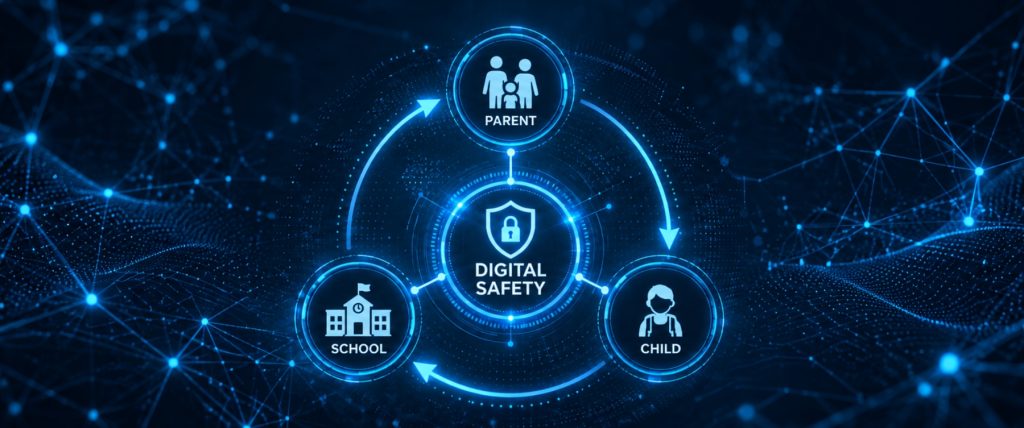
For Lebanon, I believe a viable national framework should follow a “Parent + Child + School” model.
First, digital literacy needs to become a continuous program rather than a one-time awareness session. Schools can provide age-appropriate digital safety education to students while offering parallel training for parents, with the content adapted according to the child’s age and the risks they are likely to encounter.
Second, parents need practical, hands-on training, not just awareness lectures. A parent should leave a session knowing how to activate privacy settings, recognize a phishing attempt, report harmful content, use parental controls, understand how algorithms influence what their child sees, identify signs of digital abuse, and, perhaps most importantly, have an open and constructive conversation with their child about online risks.
Third, Lebanon needs a national digital literacy curriculum and resource hub, developed collaboratively by relevant ministries, educators, technology professionals, child-safety organizations, and civil society. The material should be available in Arabic, presented in simple and practical language, and continuously updated because the digital environment and the risks associated with it are constantly evolving.
This is also the direction we are working toward as part of a national strategy with the Ministry of Information: creating a framework that does not simply react to emerging digital risks, but prepares families, schools, and children to navigate them.

We have to recognize that digital safety cannot be achieved through restrictions alone. Age limits, parental controls, and technical protections have an important role, but education, awareness, and communication are what make them sustainable. Parents need to understand the technology. Children need to understand the risks and their rights. Schools need the tools and resources to support both.
The objective should not simply be to keep children away from technology. It should be to create a generation of digitally capable children and digitally confident parents who can navigate the digital world safely and responsibly together.
In your opinion, given Lebanon’s existing digital infrastructure and institutional vulnerability, what kind of cross-sector plan is needed to build sustained digital awareness from grassroots communities up to state entities?
I believe Lebanon needs a national digital resilience strategy that brings together government, schools, universities, NGOs, the private sector and civil society. It has to start at the grassroots level, educating children, parents and communities, and extend to employees and state institutions.
We need continuous awareness, not just about phishing and scams, but also AI impersonation, deepfakes, privacy and online abuse, and clear mechanisms for reporting and responding to incidents. Digital safety should become an ongoing national culture, not a campaign we launch only after a cyber incident happens.
Parental controls and app blockers only go so far. How can families in Lebanon move from simply monitoring or blocking content, toward teaching children how to recognize deceptive algorithms, harmful content, privacy risks and unsafe online behavior for themselves?
I believe parental controls should start from the moment a child receives a device. They should be age-appropriate, with screen-time limits and safe digital habits established from the beginning. When children reach the appropriate age for social media, generally 13, in line with the minimum age set by many platforms, parents should also use the safety and privacy controls available on those platforms.
But technology alone is not enough. Communication is the foundation. The challenge is that there is often a huge knowledge gap between parents and children. Children can sometimes understand platforms, trends and online risks much faster than their parents.
That is why we need to educate parents too on: algorithms, AI, privacy, harmful content, grooming, cyberbullying and other digital risks so that when they talk to their children, they are not simply saying “don’t do this,” but actually understand why it is risky and how to guide them.
What is the proposed plan for Lebanon to build a sustainable local tech ecosystem that not only educates digitally capable generations, but also gives that talent a reason to stay, and contribute locally?
Lebanon already has the talent; the challenge is creating the ecosystem that gives that talent a reason to stay. We need to connect education with the real needs of the market, support startups and entrepreneurs, create more local opportunities, and build stronger partnerships between universities, the private sector and government.
But we also need to think beyond traditional employment. Lebanon can position itself as a hub for technology, innovation and remote global work, allowing Lebanese talent to access international markets while remaining based in Lebanon.
If we create opportunities, access to funding, mentorship and a clear path from education to employment or entrepreneurship, we can turn our talent from something Lebanon exports into an asset that helps build the local digital economy.
And this exactly is what LEBTECH next will be focusing on.
To what extent is the generational divide in digital literacy threatening to entrench wider economic and social inequalities across Lebanon?
It is a significant risk because the digital divide is no longer only about who has access to technology, it is also about who knows how to use it safely and effectively.
Younger generations may grow up naturally navigating digital platforms, while many parents, educators and older adults are trying to catch up. It’s a gap that can affect education, employment, access to services, financial opportunities and even personal safety, and that’s why digital literacy has to be intergenerational.
We cannot educate children and leave their parents behind. We need to equip every generation with the knowledge and confidence to participate safely in Lebanon’s increasingly digital economy and society.
Inside Telecom provides you with an extensive list of content covering all aspects of the tech industry. Keep an eye on our Interviews to stay informed and up-to-date with our daily articles.
