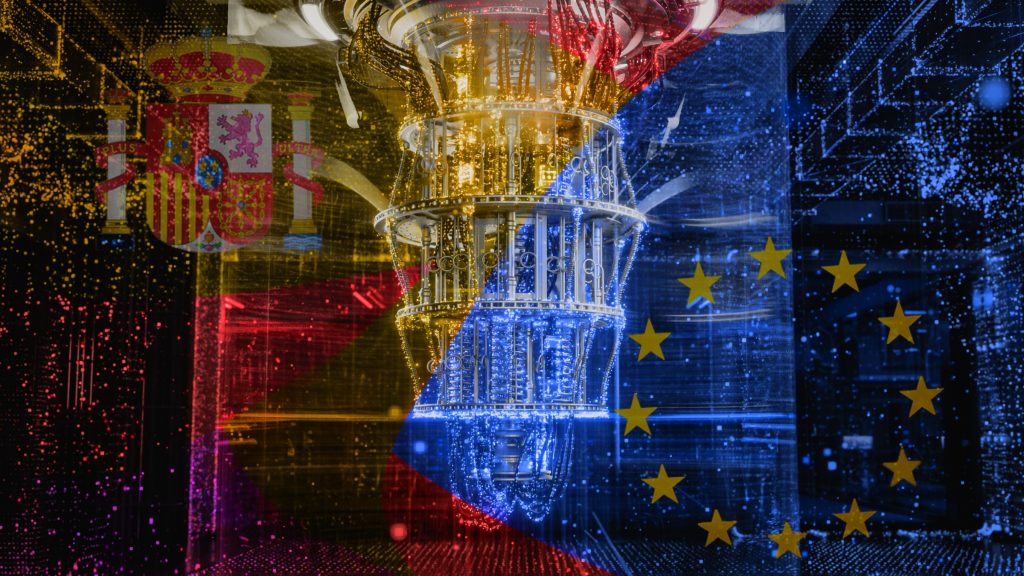
On Thursday, May 28, the Barcelona Supercomputing Center (BSC-CNS) launched a new $10.6 million analog quantum computer, EuroQCS Spain, to accelerate industrial optimization and AI capabilities through the EU quantum computing initiative.
Financed by the Spanish government and the European Union (EU), the EuroQCS-Spain has been physically installed inside the iconic Torre Girona chapel and fully integrated into MareNostrum 5 – one of Europe’s most powerful classical supercomputers.
Barcelona-based contractor, Qilimanjaro Quantum Tech built the super machine entirely with domestic European hardware and software. The deployment of the new EU quantum computing power makes the Barcelona center one of the few facilities worldwide to merge classical supercomputing with digital and analog quantum architecture into a single operational grid, accessible to researchers across the EU bloc.
By the launch of this EU quantum initiative, Barcelona claims its status as Europe’s supercomputing powerhouse. EU quantum computing can drive the region’s technological sovereignty by integrating advanced quantum processors into Barcelona’s MareNostrum5 to lead global computational innovation.
The offerings are not limited to just power, as the EuroQCS-Spain changes the language the computer uses to think, offering a fresh approach to solving the world’s most complex puzzles, fulfilling a new role under the EU quantum initiative.
Usually, classical supercomputers rely on standard bits that must be either a 0 or a 1, meanwhile quantum computers use qubits. These qubits can exist in both states at the same time, allowing them to run highly advanced calculations simultaneously.
https://youtu.be/1T5oQ2YvuEE?si=nBI_6UUmdXfOKQRY
Quantum Strategy of EU Dictated by Euro2CS-Spain
The announcement is the first true turning point for the EuroQCS-Spain contract, introducing an error-free, analog chip architecture based on fluxonium qubits that always manages complex optimization algorithms without waiting for a full fault tolerant system.
Just like each country owns a technological specialty that drives EU’s development and independency against western domination, Spain with its EuroQCS-Spain is leading the quantum computing EU race.
During the inauguration, Marta, the CEO of Qilimanjaro Quantum Tech, explained that the analog computer manages algorithms continuously and how the unique setup makes it possible to simulate problems more precisely.
“The era of artificial intelligence needs this technology, and it needs to have it at home, sovereign,” Estarellas stated, referring to the overarching quantum strategy of EU.
Secretary of State Juan Cruz highlighted that the speed of these systems is difficult to overstate, and that the quantum technology offers calculation capabilities tens of thousands of times superior to what we are used to, heavily benefiting quantum computing Spain efforts.
“This computer is clear proof that when there is political will, institutional coordination, and scientific ambition, we can achieve whatever we set out to achieve,” said Cruz.
Sovereignty Through Quantum Strategy EU
Accommodated alongside its peers in the chapel of Torre Girona, the system is being integrated into a broader network managed by the European High Performance Computing Joint Undertaking (EuroHPC JU), an initiative designed to build a world-class supercomputing ecosystem across Europe, strengthening quantum computing in Europe.
EuroHPC JU is the EU’s flagship initiative to establish a sovereign, interconnected, network of six quantum nodes across Poland, Czech Republic, Germany, France, and Spain. Brussels is establishing continental computational sovereignty by financing 100% European-sourced silicon and software pipelines.
Brussels is putting all its might into dismantling the EU’s long, and deeply rooted, dependence on proprietary US and Chinese cloud infrastructure.
Europe aims to protect its digital assets and reduce its reliance on outside tech giants -especially the west-, an explicit goal of the current quantum project EU. The Catalan government’s Minister for Research and Universities, Núria Montserrat, stressed that the project “reinforces the idea of European technological sovereignty in the face of US ‘big tech’ companies.”
Experts believe in the value of using public policy to keep driving this infrastructure forward on the global stage as part of the unified quantum strategy EU.
“We are capable of producing our own European technology in pursuit of strategic autonomy so as not to depend on third countries,” Montserrat concluded.
With the first two EU quantum computing machines at the center already clocking 4,200 hours of computing time across 53 research projects since February 2025, the arrival of this third analog system signal Spain’s role as a leader in the field.
For now, the focus remains on attaining sovereignty of EU quantum computing. The operational rollout of EuroQCS-Spain changes the structural balance of global tech power. Barcelona has now effectively built a computing blueprint that rivals the infrastructure of traditional Silicon Valley giants.
The quantum strategy of EU seems to be on its own trajectory to achieving pure geopolitical autonomy and it’s directly related to local high-tech production. By adopting and supplying these exclusive processors into MareNostrum 5, Barcelona is not just marking its presence in the global quantum race but also establishing Europe’s technological sovereignty and industrial independence.
Inside Telecom provides you with an extensive list of content covering all aspects of the tech industry. Keep an eye on our Tech sections to stay informed and up-to-date with our daily articles.
