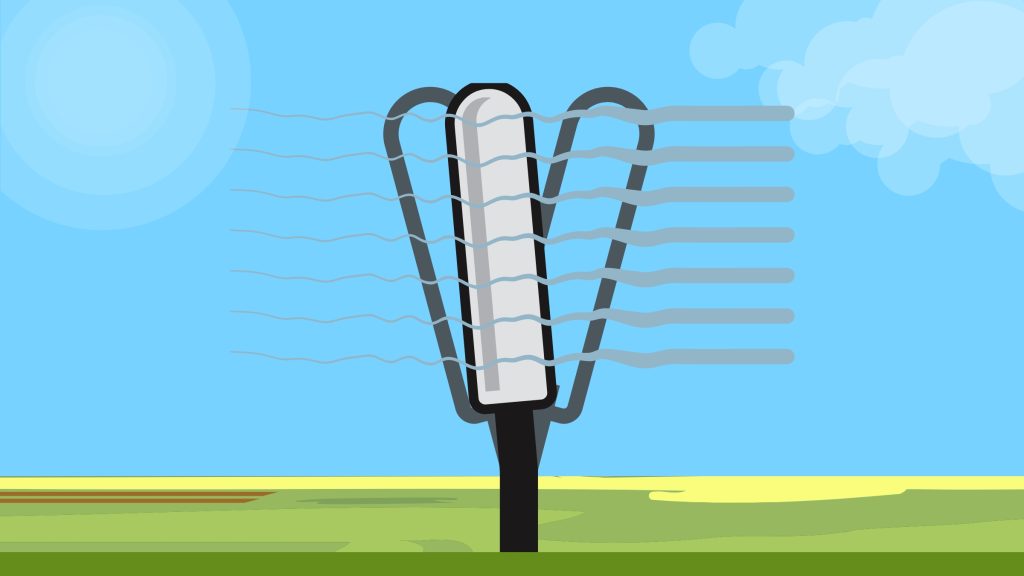
Spanish startup, Vortex Bladeless Ltd. is placing a huge bet on the concept that clean energy doesn’t need spin, developing wind-power generators – bladeless wind energy – without the traditional rotating blades or lubricants, producing electricity from vibrations as wind passes through turbines and is deflected into vortices.
The clean-energy startup’s concept is known as vortex shedding, that applies vortex induced vibration energy harvesting to convert the mast’s side-to-side movement into electricity. Vortex Bladeless spent 10 to 15 years developing the technology, from concept to end product.
Vortex Bladeless is testing a new type of electricity generation by swaying rather than spinning, offering a quieter, lighter option for homes, remote sites, telecom equipment, and smart-city systems where conventional turbines remain too large, costly, or disruptive.
While the Vortex Bladeless wind generator power output is still small, the idea is for places where it is difficult, expensive, noisy or deadly for birds and bats to install conventional wind machines. Market researchers also expect interest in wind systems as governments and businesses expand distributed renewable energy.
Electrical Wind Vibrations
Vortex Bladeless wind turbine uses an aerodynamic effect called vortex shedding. When air flows around the cylindrical mast, alternating whirlwinds form on either side and push the structure back and forth.
The device operates on aeroelastic resonance, transmitting energy to its structure by harnessing wind force, through vortex shedding. When the wind hits the cylinder oscillates, it produces swirls, AKA Vortex Induced Vibrations (VIV).
Engineers know this Vortex Bladeless wind generator pattern as a von Kármán vortex street, a phenomenon often controlled in bridges, towers, and chimneys because repeated movement can damage structures.
The Spanish developer is instead using that bladeless wind turbines motion as its energy source. An elastic rod helps the mast resonate at wind speeds, while an alternator turns the oscillation into electricity.
The bladeless wind energy system avoids rotating blades, gearboxes, bearings, and pitch-control equipment in conventional turbines, reducing the number of components exposed to wear.
The Vortex Bladeless wind turbine could make transportation, installation, and maintenance easier, for simpler construction in locations with limited space or technical support. The turbine is designed to produce less noise and lower the collision risk for wildlife because no blades sweep through the air.
According to Vortex, “the technology is not intended to replace large wind farms,” but instead, it’s developed for distributed generation, including sensors, off-grid systems, remote monitoring stations, small buildings, agricultural equipment, and telecommunications infrastructure.
That focus separates the project from the race to build a wind turbine to generate electricity with blades extending beyond 100 meters. Utility scale machines can supply electricity to grids, while bladeless models could serve smaller loads close to where power is needed.
They may also work beside solar panels and batteries, giving isolated sites another source when sunlight is weak, but wind is available.
However, the bladeless wind turbines technology remains at an early commercial stage.
The largest bladeless wind energy operational model generates about 100 watts, compared with the millions of watts produced by modern utility turbines. Engineers must improve efficiency, durability, and scalability before the machines can support broader commercial use.
Market Growth Meets Power Limit
According to Market Data Forecast, the global bladeless wind turbine market could rise from $79.69 billion in 2025 to $156.36 billion by 2033, representing an annual growth of 8.79%.
The Global Bladeless Wind Turbine Market Research Report links demand to lower production and maintenance costs, lighter structures, smaller foundations, easier installation, and growing renewable-energy policies.
The report identifies possible uses across residential, industrial, commercial, and utility settings. Applications include marine off-grid systems, remote telemetry, agriculture, domestic power, telecom networks, signage, and rail signaling. Compact units could be placed in populated or ecologically sensitive areas where large turbines face space, noise, or wildlife concerns.
Still, the market outlook comes with a technical weakness of bladeless wind energy.
“The market growth of bladeless wind turbines is constrained by the fact that they do not generate more electricity than traditional wind turbines,” according to Global Bladeless Wind Turbine Market Research.
With bladeless wind energy, each machine captures less moving air and has a smaller swept area, limiting the amount of energy it can collect.
Developers may partly address that disadvantage by installing multiple lightweight units across the same area, but total performance, cost, and reliability must be proven outside prototypes. Public availability also remains limited, leaving buyers without mature supply chains, performance histories, and service networks available for standard turbines.
For now, Vortex bladeless turbine represents an addition to the renewable energy mix rather than a substitute for established wind power
I value may come from reaching overlooked locations: rooftops, farms, telecom sites, remote communities, monitoring stations, and urban infrastructure. If testing confirms dependable output at a practical cost, swaying masts could give wind energy a quieter path into places spinning blades cannot reach.
Inside Telecom provides you with an extensive list of content covering all aspects of the tech industry. Keep an eye on our Impact section to stay informed and up-to-date with our daily articles.
