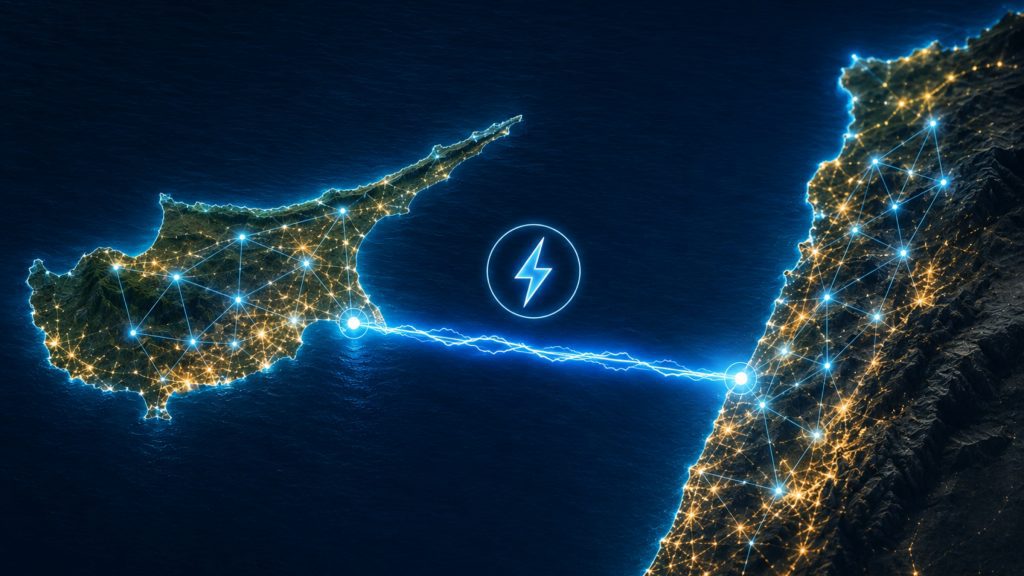
Cyprus and Lebanon are moving toward an undersea electricity link that could ease power shortages, connect its weak grid to Cyprus, and later open a route to the European electricity grid, while studies test whether the project can work safely.
The proposal remains early, but it carries unusual weight. Lebanon electric supply still faces unstable power.
The cable could provide a solution to the Lebanon power crisis, while Cyprus could strengthen its position as an Eastern Mediterranean energy bridge.
A Power Route Lebanon Needs
Lebanon and Cyprus have escalated matters to the World Bank to study whether their electricity grids can be linked through a submarine cable. The first phase of the European electricity grid, expected to take place after around six months, will examine supply, demand, costs, and the project’s wider economic case.
On July 19, Lebanese Energy Minister Joseph Al Saddi said to Alithia, that the link could become more important if Cyprus completes its planned connection with Europe. That would give Lebanon a possible route into a larger and more stable energy market.
“If Lebanon is connected to Cyprus, and since Cyprus may eventually be connected to the rest of Europe, this will be extremely beneficial for the country,” he said.
The immediate value to the issues that Lebanon electric supply is facing is simpler.
Lebanon power crisis still takes place due to major electricity shortages, leaving many people dependent on private generators and costly alternatives. A new connection could bring more power into the country and support a grid that has struggled for years to meet demand.
“The obvious benefit is that we will be able to provide more electricity to the Lebanese population,” Al Saddi said.
The plan to Lebanon power grid gained support after Cyprus and Lebanon signed an agreement defining their exclusive economic zones, ending an 18-year delay and creating clearer rules for offshore energy cooperation.
Both governments also approved technical working groups of groups on the Lebanon power grid issue and a World Bank-funded feasibility study, giving the project a formal structure for legal, financial, and engineering coordination.
“This is a milestone of strategic significance that seals, in the clearest way, the level of our relations,” said Cypriot President Nikos Christodoulides after the signing.
Timing matters in the case of Lebanon energy crisis.
The Lebanon power grid electricity sector remains a major economic problem, while public supply fails to cover daily demand. A Cyprus link would not fix every weakness, but it could add another source of power.
If Cyprus ties itself to Greece and Europe, Lebanon this cross border electricity could move the country from an isolated market to a system linked to several countries, improving supply options, energy trading and outside investment.
Financing remains the main obstacle. Private investors, the European Commission, or international institutions may help, but construction will depend on whether World Bank studies find the project realistic.
Technology Behind the Life Saving Cable
The European electricity grid would likely be using Voltage Source Converter High-Voltage Direct Current technology (VSC-HVDC). This system suits long underwater links because shifting between current cables loses too much energy over distances above roughly 50 kilometers.
In HVDC, the electricity is transmitted as direct current through the submarine cable and is converted back to alternating current by converter stations before entering the national grid, allowing power to travel long distances with less losses and more control.
Another key advantage of VSC technology for Lebanon electric grid weakness is that it can provide a black start. If part of the local grid collapses, the converter system could help restart sections of the network without waiting for power from the same damaged system.
The cable would need strong insulation and protection, catalyzing the process to end the issues that the Lebanon electricity has been facing.
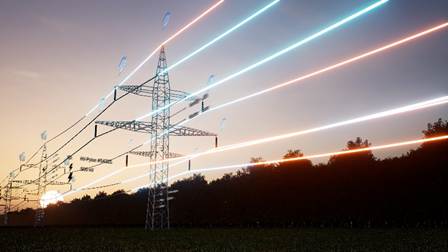
Deep Eastern Mediterranean waters bring pressure and seismic risks, requiring mass-impregnated or cross-linked polyethylene systems with heavy armoring.
Converter stations would also separate Lebanon’s unstable grid from the European system. Europe’s interconnected network operates at 50 hertz under strict stability rules, while Lebanon’s grid can suffer from frequency changes and faults. HVDC stations would act like a firewall, moving power without passing those problems between systems.
Advanced monitoring would be essential in these ongoing electricity shortages.
Energy Management Systems and Supervisory Control and Data Acquisition platforms would monitor real-time electricity flows, voltage, faults and network conditions. These controls would help the interconnector fully meet European grid rules and prevent faults in one network from spreading into the other during operation.
The project would also depend on Cyprus strengthening its own connection to Europe through the Great Sea Interconnector. That system is planned as a 2,000 MW, 500 kV VSC-HVDC link through deep Mediterranean waters.
A future Cyprus-Lebanon European electricity grid could connect to that backbone and give Lebanon indirect access to Europe.
Before construction, engineers must study seabed terrain, cable routes, converter station locations, capacity, and environmental risks.
For Lebanon, the European electricity grid is not only about regional strategy, but also about whether a country facing repeated blackouts can gain a new electricity route, strengthen its grid, and move closer to a wider energy system offering more stability than it has today.
Inside Telecom provides you with an extensive list of content covering all aspects of the tech industry. Keep an eye on our Impact section to stay informed and up-to-date with our daily articles.
