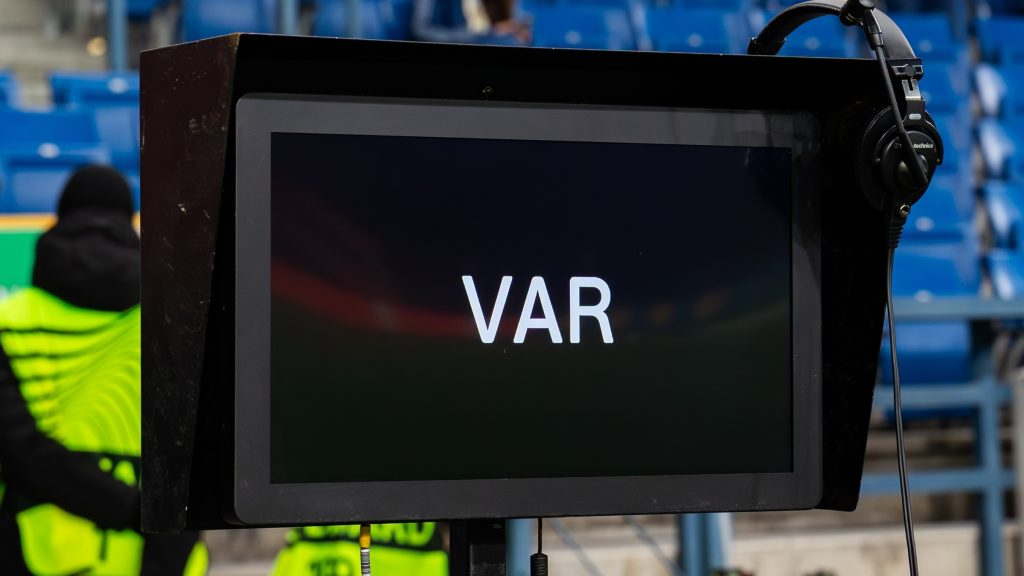
The referee’s officiating infrastructure at the 2026 World Cup demonstrated what sports measurement VAR in football technology can achieve.
The VAR in football system has performed flawlessly, with perfect data. But, as it turned out after the Argentina VS Egypt, and Switzerland VS Argentina matches showed that this level of perfection, is actually the problem in a very human-centric game.
The VAR system has 12 dedicated tracking cameras rendering 29 data points per player, 50 times per second, paired with the 500 hertz (Hz) connected ball sensor in the Adidas Trionda.
On July 7, when Argentina defeated Egypt 3-2 in the 2026 World Cup, as contested video reviews placed VAR in football at the center of a formal Egyptian complaint over several match-changing refereeing decisions during the tense game. Same thing happened in the Switzerland VS Argentina games.
The Argentinian comeback in both matches renewed questions about whether cameras, AI and slow-motion replays can produce fairer decisions when referees still control technology’s application.
No one is denying that the VAR in football system performed flawlessly. By every technical measure, it didn’t malfunction, lag, miss a touch, a trajectory, or a position.
But for researchers at Northeastern University, and analysts at Wired, the data architecture they have examined found absolutely nothing wrong in VAR. What they found wrong, though, is everything downstream of it. So, it’s not a engineering problem.
Cameras, AI and Human Judgment
When you have perfect data delivered live to FIFA officials operating under pressure, then the rulebook that was established before this high quality of data existed, then confusion will happen.
The official rulebook in the case of these matches failed to produce perfect decisions. But is football about perfect decisions, or what meets the eye? This year’s implementation of VAR in football produced a new – and more confounding – category of controversy, coming from the fans, players, coaches, and Switzerland and Egypt’s football associations.
And unlike common belief, this isn’t the first year the system was integrated into FIFA’s matches. But what this year’s VAR integration has demonstrated that the errors it cannot correct are the ones that were never about perception in the first place, nor about a failure of data acquisition and perception.
VAR first appeared at a World Cup in Russia in 2018, with FIFA describing it as “a support tool for the on-field refereeing team.” It was used again in Qatar in 2022 and now operates in more than 100 competitions.
Compared with football before VAR, officials have far more visual evidence. At the 2026 tournament, the review team can use feeds from 42 cameras, including slow-motion footage.
A video assistant referee and three assistants examine the available angles before reporting an error. Despite the setup, VAR in football does not make the final call. That remains with the on-field referee.
One of the main benefits of VAR in football is its ability to detect details missed by the human eye. Reviews cover goals, penalties, red cards, mistaken identity, and offences linked to scoring situations.
For the 2026 World Cup, the system’s role was expanded. It can review incorrect second yellow cards, some corner-kick decisions and fouls before set pieces, adding new layers to football and VAR discussions.
AI also creates 3D player models to explain offside decisions. The images show whether part of a player’s body crossed the digital line. This makes VAR in football more precise, but not less controversial.
The advantages and disadvantages of VAR in football remain closely connected. Greater accuracy can improve fairness, but long reviews may interrupt matches, frustrate supporters and delay celebrations.
“There’s so much skepticism and controversy around communicating to the audiences what technology can add to the experience of the game,” said Northeastern professor Casper Harteveld.
Training, camera placement, communication and referee interpretation are among the factors that affect VAR in football. Even strong technology cannot ensure consistency if officials apply rules differently.
“The thing that people love about sports is the human element of it,” said Stephen Warren.
Therefore, Egypt’s complaint shows that VAR in football may improve accuracy, but trust still depends on trained officials, consistent rules and transparency.
Egypt Exposed VAR’s Contradictions
Egypt led by two goals before Argentina recovered to win. After the match, the Egyptian Football Association said, “the failure to properly use VAR” had affected several decisions by the referee and influenced the score.
The Egyptian association filed a protest against FIFA.
“The Egyptian Football Association cannot remain silent regarding the refereeing decisions observed during the match against Argentina,” it said in a social media statement.
The controversy has brought the benefits of VAR in football back into focus. Supporters say video review can correct clear mistakes, examine incidents from several angles and reveal missed details in real time.
Egypt’s complaint also reflects wider arguments against VAR in football. Critics believe similar incidents can produce different outcomes, leaving supporters unsure whether the system is applied consistently.
The relationship between football and VAR has produced other disputed moments. Germany had a possible winning goal against Paraguay cancelled, while Belgium received an extra-time penalty against Senegal.
A review also contributed to the red card shown to US striker Folarin Balogun. These incidents show that VAR in football can influence results and player availability.
Inside Telecom provides you with an extensive list of content covering all aspects of the tech industry. Keep an eye on our Intelligent Tech sections to stay informed and up-to-date with our daily articles.
