On May 31, NVIDIA and Microsoft introduced RTX Spark, a Nvidia personal AI computer concept, and DGX Station for Windows, setting the first foundational pillar of AI computing to laptops, desktops, and enterprise workstations worldwide through new hardware, software, and security tools designed to run AI agents directly on devices and within everyday workflows.
Nvidia and Microsoft’s announcement at Computex will fundamentally change the long-standing fact that PCs have spent four decades as a tool that waits for instructions. Now, with the Nvidia personal AI computer introduction, the AI-machine integration is unified.
For years, the industry told consumers that AI requires the cloud, then Nvidia and Microsoft shook hands and put one petaflop on a consumer motherboard and made the argument considerably harder to sustain.
The RTX Spark is an ARM-based architectural system-on-chip (SoC) that integrates a Nvidia Blackwell-generation Graphic Processing Unit (GPU), with 6,144 CUDA cores, fifth-generation FP4 Tensor Cores. The RTX Spark has a custom 20-core Grace Central Processing Unit (CPU) via NVLink-C2C interconnect.
Basically, put simply, the RTX Spark will be the high command center, with the 20-core CPU acting as the smart manager tackled with basic tasks. The massive CPU will function as a specialized engine built specifically for AI.
The information sharing operations will happen instantly as they are both joined by a super fast bridge. The PC will be able to run extremely complex AI features locally, such as live translation or smart assistance. All this will happen without needing to send any private data to the internet.
Pairing of Nvidia’s OpenShell runtime and Windows containment primitives – shared operating system security layer – will isolate the automated AI agents within secure, hardware rooted sandboxes, which eventually allows consumer PCs to orchestrate multi-step workflows without surreptitiously sending personal data to the cloud through compute AI capabilities.
AI Agent Takes Control of Computer
For decades, personal computers have revolved around applications that users manually opened and controlled. Now, the Nvidia personal AI computer announcement argues that AI agents will become a new layer of computing, allowing users to issue requests while intelligent software completes the work.
Microsoft and the chip giant describe the innovation as a new phase of the Nvidia personal AI computer, saying future PCs will be purpose-built for AI agents that can operate locally, securely, and with greater autonomy than traditional software applications.
“The PC is being reinvented,” said, founder and CEO of NVIDIA, Jensen Huang, adding, “For forty years, you launched apps. Click. Type. With RTX Spark and Microsoft Windows, you ask – and the PC does the work.”
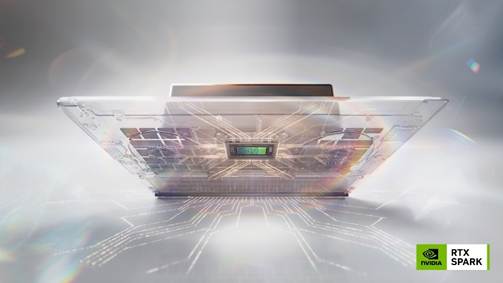
Developed with support from, Nvidia’s RTX Spark AI computer build is designed to power slim laptops and compact desktop systems while supporting demanding AI workloads.
NVIDIA says RTX Spark can run local AI agent PC securely and privately, a capability the company believes will help drive broader adoption of autonomous software assistants.
Through Nvidia OpenShell and new Windows security primitives developed with Microsoft, users can control what AI agents can access, limit how they operate, and protect sensitive information before data reaches cloud services.
Microsoft said the platform is being optimized to support agentic workloads locally through Windows security, containment, and management features, giving users greater visibility and control over how AI agent PC operate on their devices.
The Nvidia personal AI computer platform is already drawing support from developers behind projects such as and, whose AI agents are expected to run directly on Windows devices powered by RTX Spark.
“Our goal is to deliver unmetered intelligence to every home and every desk with Windows,” stated RTX Spark.
Microsoft and Nvidia said the collaboration is another step in an extended partnership across gaming, cloud computing, and computer vision in AI automation, with a shared view that AI agents will play a key role in future personal computing.
Enterprise AI Sent to Your Desk
Alongside Nvidia RTX Spark PC, NVIDIA introduced DGX Station for Windows, a deskside AI supercomputer aimed at enterprise users, developers, engineers, and researchers.
Powered by Nvidia’s GB300 Grace Blackwell architecture, the system is capable of running AI models with up to one trillion parameters locally. It includes a 72-core Grace CPU, a Blackwell Ultra GPU, up to 748GB of memory, and networking speeds reaching 800Gb/s.
Prior to the announcement, advanced AI that can control your computer development has largely been confined to Linux-based data centers. Now, Nvidia and Microsoft say DGX Station changes that by bringing data-center-class AI computing directly into the Windows ecosystem used by most enterprises.
Nvidia CEO said organizations will be able to build, deploy, and manage hundreds of AI agents simultaneously while maintaining the security, compliance, and management tools already used across Windows environments.
The Nvidia personal AI computer system is also designed to support AI model training, fine-tuning, inference, data science workloads, and physical AI applications. The news comes as edge computing options for AI inference applications become a geopolitical issue.
Inside Telecom provides you with an extensive list of content covering all aspects of the tech industry. Keep an eye on our Intelligent Tech sections to stay informed and up-to-date with our daily articles.