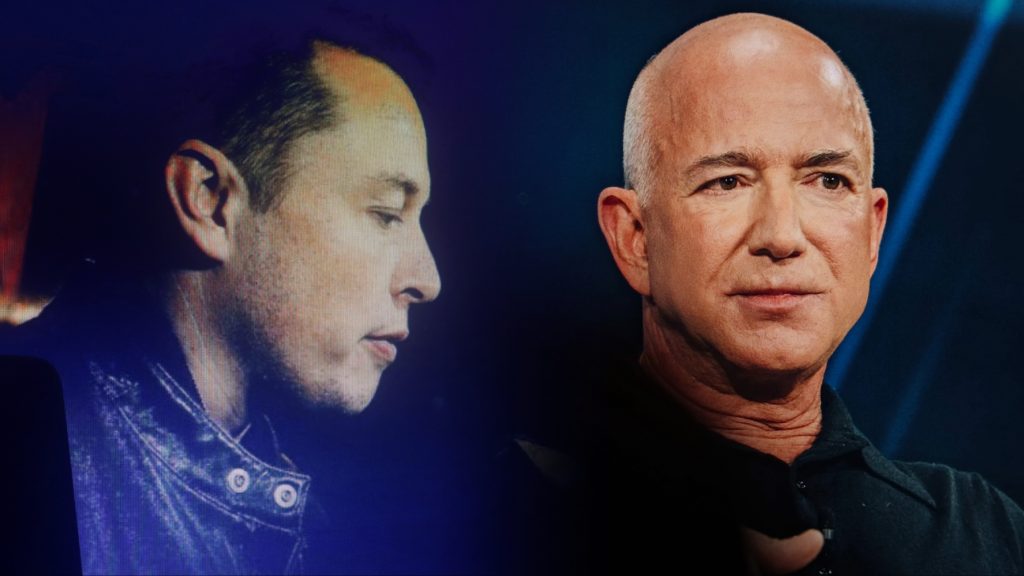
On Monday, SpaceX’s S-1 filing arrived with the weight of a document that’s igniting deep anxieties on Wall Street’s trading floors over AI and aerospace valuation bubble, with CEO Elon Musk asking the public markets to believe – distilled to its essential proposition – that if SpaceX, one of the rising space empires, is generating a certain capital of annual revenue then it’s worth 93 times that amount.
SpaceX is marching toward a monstrous $1.8 trillion initial public offering (IPO) as Wall Street starts doing the math. And needless to say, in the eye of the money bull traders, something’s not adding up amidst widening fractures in the billionaire race of space empires.
Elon Musk’s SpaceX and Jeff Bezos’ Blue Origin accelerated their multi-billion-dollar battle over orbital tech through the weaponization of space infrastructure to lock down their competing space empires and establishing AI that extends from Earth to the stars.
The world’s most powerful tech giants are using their massive cloud monopolies to gain control, in an effort to beat the rival to their IPO. Musk’s SpaceX and Bezos’ Blue Origin are building an exclusive ecosystem of satellite networks, and data hubs, constructing a digital fortress in orbit.
It’s all dependable on how Musk and Bezos leverage their absolute control over cloud data infrastructure on Earth to slowly suffocate rivals out of the celestial supply chain.
Space is quickly becoming the ultimate home for remote AI servers powered by the sun, with space empires forcing their cloud and AI monopolies to permanently choke out all orbital competition.
Space Empires Fight Over Domination
At the center is the huge computing power required to run next-generation AI. SpaceX took a massive step forward by using its newly absorbed AI branch to quickly construct the Colossus and Colossus II data center facilities in Memphis, Tennessee.
Elon Musk orbital data centers want to blend heavy computing power directly with rocket launch capabilities to control the market.
According to recent public filings, SpaceX has capitalized on this infrastructure by locking in a deal with Anthropic, urging it to pay $1.25 billion each month, through May 2029, to rent computing power.
The big deal highlights the great profitability of data infrastructure, providing steady cash flow to Musk’s otherwise costly rocket-building operations.
“Our first-principles thinking enables us to build coherent compute at scale and at rapid speed with lower costs than most other companies in the industry,” SpaceX said in its filing.
However, Amazon is fighting back aggressively to protect its territory and secure Bezos’ own future space empires. Andy Jassy, Amazon Chief Executive, announced a $200 billion investment budget for 2026 alone, focusing heavily on custom-made AI chips and physical infrastructure to counter his rival.
Amazon Web Services (AWS) already runs an $11 billion campus in rural Indiana dedicated to running AI models for Anthropic, which in turn pledged over $100 billion to AWS over the next decade. By attaching these AI giants to Earth-bound servers, Amazon aims to neutralize Musk’s grand visions of deploying highly scalable orbital data centers before they can even leave the atmosphere.
Exploding Rockets and Volatile Nasdaq
While the data war between space empires rages on the ground, the physical infrastructure needed to reach space remains incredibly fragile. Jeff Bezos experienced this firsthand when Blue Origin’s massive New Glenn rocket exploded during a launchpad test at Cape Canaveral, Florida.
The following setback complicates the timeline for Blue Origin orbital data centers, which rely on the heavy-lift rocket to get their specialized payloads into orbit. The fiery setback dealt a heavy strike to Bezos’ plans to deploy Amazon’s internet satellites and narrow the gap with SpaceX’s dominant Starlink network.
Despite the catastrophic loss of the vehicle, Bezos remained firm on social media.
“It’s worth it,” he wrote.
Yet, the explosion sent shockwaves through the financial markets, causing stock prices for smaller, independent space infrastructure companies to fall and proving just how tightly tied the industry is to the fortunes of its billionaire leaders. Meanwhile, Musk faces his own challenges as he prepares a massive SpaceX public listing on the stock market.
The highly anticipated SpaceX IPO plans have dominated Wall Street discussions, with investors eager to buy into the world’s premier launch provider. The company’s S-1prospectus targets a historic Nasdaq debut aiming for a market valuation between $1.75 trillion and $2 trillion. To put this commercial space race into perspective, a successful listing at the top of this range would immediately place SpaceX behind Amazon as one of the world’s most valuable entities.
Musk is seeking a 93 times price-to-sale ratio, and when divided into revenue, that’s a huge number. Financial historians have a name for valuation at that multiple, and it’s “Dot-com Peak,” and it doesn’t really fit with Musk’s SpaceX.
I would like to point out that using dot-come peak synonymously with SpaceX is not deployed as a compliment, and what the financial community is quietly working through is not simply the SpaceX valuation in isolation, but it’s actual position in a queue. Especially that OpenAI is also preparing to go public.
Wall Street indexes are bracing for the complete scale of the listing; index funds that track the Nasdaq and the Russell 1000 are expected to guarantee approximately 24% of the available public float, forcing passive managers to reallocate vast sums of capital.
https://twitter.com/elonmusk/status/2059880289514696927
This high-stakes tension underscores the ultimate reality of industry, which has turned the traditional commercial space race into a win or lose infrastructure battle. The billionaire space race is becoming a fierce domination war to control the infrastructure of the future digital economy.
As independent space infrastructure companies watch the margins shrink, the barrier to entry continues to skyrocket. The goal for these titans is to ensure their respective space empires control the data routing of the next century.
Analysts warn that if current trends hold, late-stage SpaceX IPO plans and Amazon’s massive capital deployment will leave very little room for anyone else. In the end, the smaller space infrastructure companies may find themselves forced to rent tech from the monopolies they hoped to compete against, strengthening the domination of their space empires for generations to come.
Inside Telecom provides you with an extensive list of content covering all aspects of the tech industry. Keep an eye on our Tech sections to stay informed and up-to-date with our daily articles.
