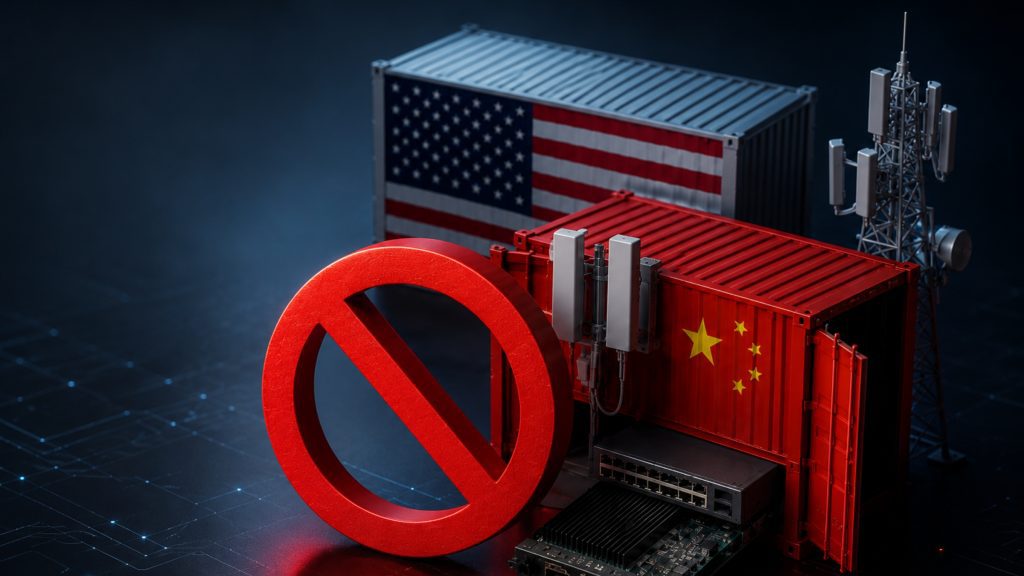
On June 28, the Federal Communications Commission (FCC) expanded its US ban on Chinese telecom imports, targeting older approved products from some of the country’s biggest telecoms equipment suppliers, such as Huawei and ZTE, as Washington seeks scrutinizing protection of communications networks.
The news expands the authority of the first ban, initially focused on new equipment approvals. Now, products that were already cleared up before, with earlier rules, can no longer enter the US market once the restrictions take effect in early July, banned in
The technology dispute between the US and China is digging deeper and deeper into networks, devices and supply chains. Chinese consumer routers in March. now legacy telecom and surveillance gear in June.
FCC Chinese Tech Restrictions
The FCC said the new rules apply to equipment made by Chinese companies already on its “Covered List,” including Huawei Technologies, ZTE, Hytera Communications, Hikvision and Dahua Technology.
Washington considers these companies possible national security threats because their products may be used in sensitive communication systems.
The FCC first blocked new approvals for equipment from these companies in 2022. The latest order closes that gap by stopping additional imports of covered telecom and video surveillance equipment from telecoms equipment suppliers already seen as risky by US officials.
The ban does not force consumers or businesses to remove devices they already use. Instead, it blocks new imports from entering the market.
The FCC is also preparing for a wider vote next month that could ban the sale of any device containing components from companies on the Covered List. That would mark a major shift.
A phone, tablet or connected device could be blocked even if it is not branded by Huawei or ZTE, as long as it contains parts linked to Chinese telecom equipment manufacturers.
The American would push device makers to take a deeper look into their supply chains more closely, and companies may need to trace chips, boards and, other network hardware back to their source before selling products in the US.
For manufacturers, that could mean redesigns, delays, higher costs and new testing before products reach stores. But this is not the first time the agency has already taken other steps against Chinese technology.
In December 2025, it restricted imports of new Chinese-made drones. The FCC also launched “Operation Clean Carts” in October 2025, to target online listings for prohibited devices on e-commerce platforms.
Then in March 2026, it limited new Chinese consumer routers.
European Networks Under American Microscope
The US on Chinese telecom equipment manufacturers comes as other countries are also reviewing the role of telecoms equipment suppliers can play in the establishment of their networks.
Montenegro, a Southeast European NATO member, is now pressured by the US and the European Union (EU) to remove Chinese-made telecom hardware from key network systems.
According to Montenegro’s communications regulator, all three of the country’s main mobile operators use Chinese equipment, with some relying on ZTE in core systems, and other on Huawei in radio access networks, including 5G equipment.
Now, it’s a game of control on global telecoms equipment suppliers and how much power does one country over sensitive national network infrastructure.
Western governments argue that telecom networks are too sensitive to depend on vendors that may be subject to pressure from Beijing, with the main concern not only being about telecom hardware, but also software updates, remote maintenance and access to network management systems.
“Financially, replacing the core and radio access network is the heaviest burden,” said telecommunications expert, Aleksandar Mastilovic, on how replacing such systems is expensive, especially for smaller markets.
For countries reviewing Chinese telecom equipment manufacturers, the real hurdle, that would eventually require a pivoting strategy is both technical and financial.
The thing about removing old systems is that it can affect network hardware, software support, and 5G upgrades. But in the eyes of mobile network operators (MNOs) that means they must choose between keeping costs low and moving to suppliers that aren’t deemed a national security threat by the US, and its allied EU.
Then you have the matter of trade, where it’s about who controls the technology behind 5G, data centers, routers, drones, surveillance tools and future connected devices. As more governments review Chinese telecom equipment companies, telecom networks are becoming a central part of the global technology rivalry between Washington and Beijing.
The US China competition for the first place of global economy, reigning as the world’s superpower, which can only be achieved by winning the tech, AI, space, telecom, and quantum, the role of networking hardware companies and the wider telecom hardware market are vital.
Governments now want more visibility into where parts come from, who updates them, and who may access them remotely. For major telecoms equipment suppliers, trust has become as important as price or performance.
The FCC’s latest action is telling the world that the US is no longer looking only at finished products, but telecoms equipment suppliers around the world. The next stage of competition will be shaped by security rules as much as by technology.
Inside Telecom provides you with an extensive list of content covering all aspects of the tech industry. Keep an eye on our Telecom sections to stay informed and up-to-date with our daily articles.
