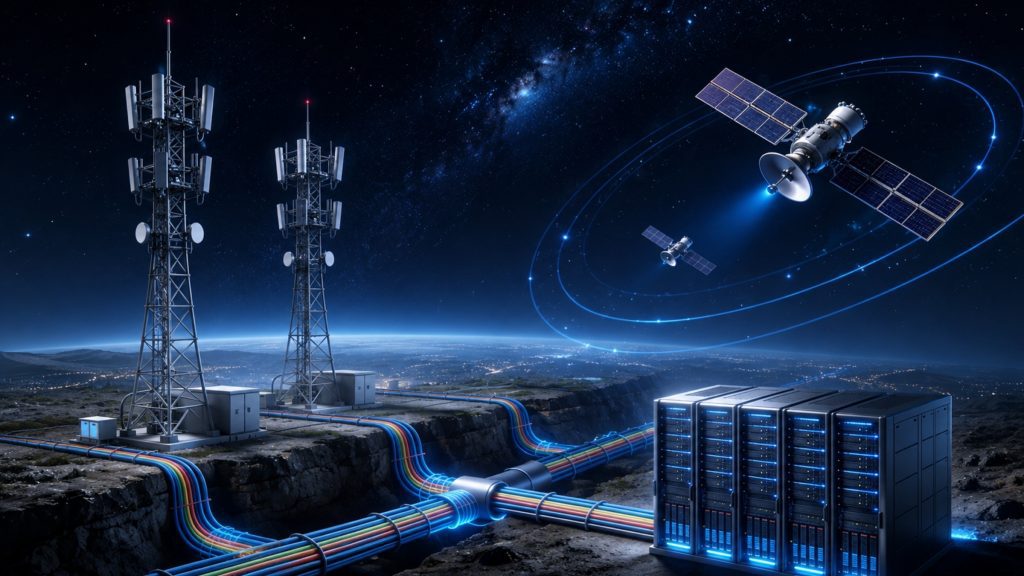
For most of the last decade, the space industry’s most defining metric was dollars per kilogram per orbit. It’s the same figure that SpaceX spent years driving down with the methodical persistence that long understood economics better than poetry. But that’s no longer the case. The new case is more about how seamlessly LEO satellite constellations anchor into terrestrial networks.
Earth has begun running out of the things data centers need the most, land, and more pressingly, power. Moratoriums on new terrestrial data center construction, which is driven by grid constraints that the AI boom has so eloquently exposed, have left hyperscale platforms confronting a new reality.
The reality is that orbit, once valuable as a key advantage point, might be more usefully understood as real estate in the eyes of those in the space race, such as SpaceX and Amazon.
SpaceX’s Musk and Amazon’s Bezos are no longer worried about the cost of getting to space, but what to do once they’re there. Semiconductors will be hardened by radiation and developing laser networking with ultra-high-bandwidth transmission between satellites without touching the ground.
These big companies, consequential to the future of the space race, are developing multi-orbit direct-to-device routing systems that treat the distinction between low-Earth orbit (LEO) and geostationary placement as something to be tactically addressed, and not as a fixed constraints.
The race to get to space, having been substantially won, has been replaced by the race to own what’s already up there. All happening right under our noses. The new architectural evolution is converting LEO satellite constellations from mere signal relays into autonomous computing environments.
Amazon Made Sure Starlink’s LEO Monopoly Ends
It is official. The LEO broadband market is fractured into a two-horse race, taking 2026 into the most capital intensive satellite competition in the commercial space history.
SpaceX’s satellite broadband division has exceeded 10 million subscribers across 160 countries, operating around 9,600 satellites and generating an annual revenue of around $11.4 billion, according to Via Satellite.
For the better part of half a decade, Musk’s SpaceX operated in LEO the way few infrastructure companies can, as the only option, set its own prices, service terms, and deployment pace without any competitor that can force concessions.
But that’s all over.
Bezos’ Project Kuiper, rebranded as Amazon Leo, is mounting an aggressive offensive worth billions of dollars. Bezos is declaring war, moving past the planning and pilot deployment phase.
Amazon’s accelerated launch cadence aggressively enough to place 700 Kuiper satellites in service, as it operated under federal deployment mandates requiring half of its planned LEO constellations architecture in orbit by mid-2026.
In this case, the spectrum dimension matters more than the satellite counts. LEO broadband operates within finite, internationally coordinated frequency bands. As Amazon’s Kuiper’s constellation density increases, the operational headroom SpaceX and Amazon have always relied on for network optimization narrows correspondingly.
So, the story’s no longer just about two tech billionaires, with knacks for building rockets, competing for subscribers. It’s about two giants competing for a physically constrained resource where early positioning carries lasting structural advantage.
LEO Satellites Connectivity Differentiating the Competition
According to TechRadar Pro, terrestrial fixed networks are buckling under the data latency demands of automated systems, with orbital companies, such as Axiom Space and Los Angeles-based startup, Orbital, being forced to deploy purpose-built AI inference nodes directly into LEO satellite constellations.
These floating server racks eliminate the hefty environmental overhead of ground facilities by capitalizing on space as an infinite passive heat sink and harnessing the unfiltered solar energy densities up to five times greater than on Earth.
The infrastructure allows them to connect and process massive amounts of data and implement AI applications worldwide. As the need for fast communication, data processing, and AI increases, so does the intelligence of satellites.
Anchored by Severe Routing Hurdles
Fulfilling the transition from a launch market to an integrated telecommunications grid represents the same issues of severe routing that engineers spent long decades trying to solve on land.
As for winning for the space race with such an architectural evolution means the race itself is no longer based on vertical integration of launch pad, but the actual mastery of complicated spectrum orchestration of multiple vendors, post-quantum cryptographic key distribution, and thermal management to guarantee localized GPUs bound to space can continuously process AI models without melting behind the clouds.
LEO Satellites Connectivity and Global Communications
LEO satellites operate between 160 and 2,000 kilometers above Earth, much closer than traditional geostationary satellites. Since the signal has to pass through a shorter path, LEO satellite constellations experience less latency and faster data response time.
Therefore, this kind of technology is perfect for LEO satellite internet, earth observation, navigation, and modern communication. The concept of deploying a few large satellites is being replaced by a system where even hundreds of smaller satellites are deployed.
Building such networks demands a lot more than just good launch operations. It is required to integrate radiation-resistant semiconductors, advanced computer technology, AI processing hardware, energy-efficient technology, and high-speed radio frequency communications into small satellite platforms that can withstand years of space’s harsh conditions.
Additionally, network capabilities have become one of the leading focuses of the industry. Contemporary satellites more often connect with each other via optical and laser links and then pass their information back down to earth.
These space connections offer enhanced speeds and better Leo satellite communication.
Instead of building on top of what already exists, satellites are expanding the scope of terrestrial connectivity to areas which are difficult to connect using conventional fiber networks.
Reaching Space to Win the AI Race
AI has increased the need for computing power, demanding vast electricity, cooling, and computing capacity, pushing researchers and developers to seek alternatives means.
Orbital data centers as assessed as the most promising solutions. Rather than conducting all AI operations on Earth, future computing will eventually run in space and will be powered by continuous solar energy, as well as cold temperatures.
Although the concept is still in its infant stage, it does show how quickly AI infrastructure is evolving, but also brings into reality the need for connectivity, not just computing.
Information must move from satellites to cloud systems, end-users, and ground stations while simultaneously ensuring terrestrial connectivity. Now, engineers are working on optical communication systems, laser connections, and routing technologies for space satellite connection.
Future success will depend on who controls communications, computing, networking, and infrastructure, not just launch capabilities.
Inside Telecom provides you with an extensive list of content covering all aspects of the tech industry. Keep an eye on our Telecom sections to stay informed and up-to-date with our daily articles.
