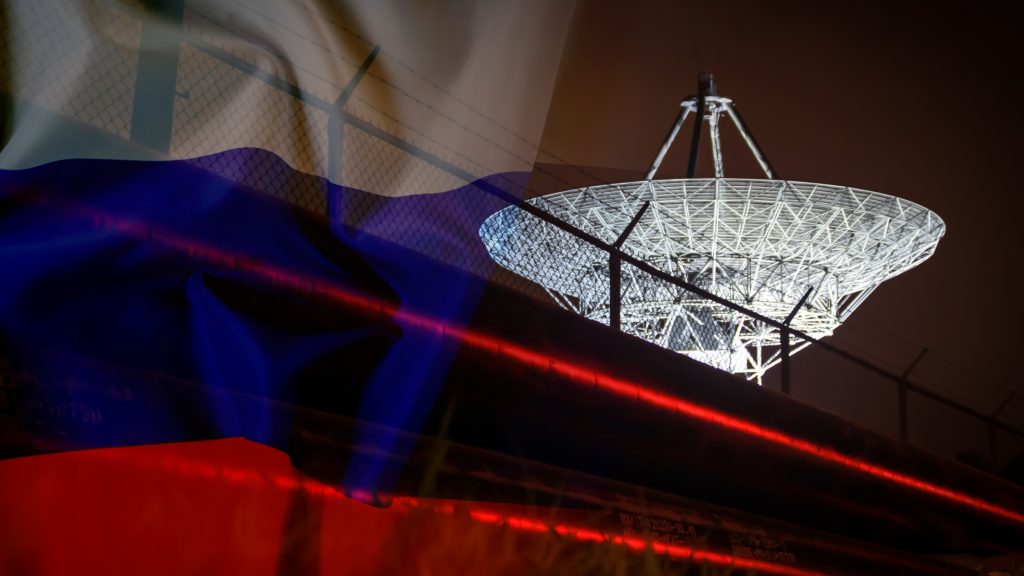
The Kremlin is building Russia’s Starlink rival, a domestic satellite internet constellation to replace SpaceX’s internet access its forces lost after Musk moved to disable unauthorized terminals used informally by Russian troops earlier in the Ukraine war, according to Radio Free Europe.
Moscow is accelerating deployment of its Rassvet communications network as Ukraine assesses how the system could affect battlefield connectivity, drone operations, and the communications advantage Kyiv has gained through SpaceX’s Starlink low earth orbit satellite constellation.
Rassvet is being developed by Russia’s Bureau 1440, a private Russian aerospace company under IKS Holding. The company launched its first batch of 16 operational satellites in March, followed by a second batch 16 in July. Around 40 satellites are now in orbit, according to Ukrainian satellite communications expert, Volodymyr Stepanets.
Ukrainian intelligence says Moscow aims to deploy 292 satellites by the end of 2027, creating a network intended to provide persistent communications comparable in purpose, though not scale, to Starlink.
Of the initial 16-satellite batch, 12 reached their planned orbit, and one satellite was subsequently lost.
Rassvet Pushes Toward Wider Coverage
The Rassvet satellite project began with test spacecraft launched from Vostochny Cosmodrome in 2023, followed by three larger prototypes in May 2024. Those trials tested data transmission, communication stability, 5G Non-Terrestrial Network (NTN) technology, and laser links before production deployments began earlier this year.
The supporting article says Russia plans 156 satellites in 2026, 292 in 2027, and 318 in 2028 under its federal Internet Access Infrastructure project. Bureau 1440 has also indicated that the constellation could exceed 900 satellites by 2035 if more capacity is required.
On June 12, Russian President, Vladimir Putin, has discussed the project, explicitly in the context of Russia-Ukraine war, telling soldiers during a Kremlin meeting that development was “proceeding at a good pace” and that he hoped troops would “feel it on the ground soon.”
Russia has separately banned the import of foreign satellite communication systems, including Elon Musk’s Starlink, making a domestic alternative a matter of declared national security.
As of August, the Rassvet satellite constellation passes over Ukraine around four times a day, though a stable connection lasting on to 1.5 hours is currently possible only twice a day.
The Russian government has committed about $1.26 billion (102.8 billion rubles) to the program, with Bureau 1440 planning to extend the investment range to roughly $4 billion (329 billion) of its own capital through 2030.
That trajectory is turning Russia’s Starlink rival into an immediate battlefield concern for Ukraine. Major General Vadym Skibitskyi, Defense, said that Russia’s low earth orbit satellite constellation of satellites already provides brief windows of tactical service when passing over Ukrainian territory. “And they began launching them much faster than their plans had anticipated. By March 2026, Russia had already launched 16 satellites into Earth orbit. And they will continue to launch others to create a constellation totaling 292 satellites by 2027 and expand it to 924 satellites by 2035,” Skibitskyi said.
Despite the coverage’s continuity, 24/7 coverage will require a much larger low earth orbit constellations,
Moscow’s accelerated launch means these orbital passes are being leveraged for operational and strike targeting of long range.
The expansion matters because Starlink in the Russo-Ukrainian war demonstrated how satellite connectivity can support command and control, battlefield data transfers, and drone operations. Space systems engineer, Ian Muirhead, told RFE/RL that modern militaries require high-capacity communications and satellite networks to maintain them in active conflict zones.
The planned Russian Starlink alternative remains far smaller than SpaceX’s network, which the first article says operates more than 10,000 satellites.
Even so, a functioning low earth orbit satellite constellation could significantly improve Russian military connectivity and tactical resilience. The Rassvet network would rely on a dense mesh of spacecrafts passing overhead in rapid orbit cycles, rather than a few distant geostationary satellites.
Ground Stations Could Become Key Targets
Yet Russia’s Starlink rival faces the vulnerability of ground infrastructure. LEO satellite systems rely on terrestrial gateway stations linked to terrestrial networks, sending data to orbiting spacecraft before transmission back to users.
Ukraine’s Starlink service is supported by stations in Poland, Lithuania, and Turkey, all NATO members. Russia would risk a wider confrontation by attacking infrastructure in those countries. Russian Rassvet gateways, however, could be located on Russian territory and become targets for Ukraine’s long-range strike capabilities.
“I’m sure Russia’s priority targets are Starlink, but they can’t destroy the Starlink ground stations, whereas Ukraine can attack. Even if [a Rassvet ground station] was in Siberia, there’s nothing to stop Ukraine attacking that,” Muirhead said.
That vulnerability could limit the military tactical impact of Russian Starlink if Ukraine locates and strikes the gateway stations supporting front-line forces.
Still, the Rassvet satellite network does not need full commercial coverage to deliver military utility. Ukrainian intelligence warns that intermittent connectivity is already enough to guide long range strike drones and coordinate assaults.
The acceleration of the Rassvet satellite internet launch will determine how quickly Moscow coverts these orbital passes into continuous operational coverage.
Russia would need more frequent Rassvet satellite launches to reach 292 satellites by the end of 2027, while launch capacity remains a major constraint cited by space security experts.
For Kyiv, the emergence of Russia’s Starlink rival adds another technology challenge as both sides seek resilient communications and electronic-warfare advantages.
The rise of low earth orbit constellations is increasingly tied to military operations. And while Starlink in the Russo-Ukrainian war continues to demonstrate their strategic value, whether Russian Starlink reaches its planned scale will depend on launch tempo, satellite production, and the survivability of supporting infrastructure.
Inside Telecom provides you with an extensive list of content covering all aspects of the tech industry. Keep an eye on our Tech sections to stay informed and up-to-date with our daily articles.
