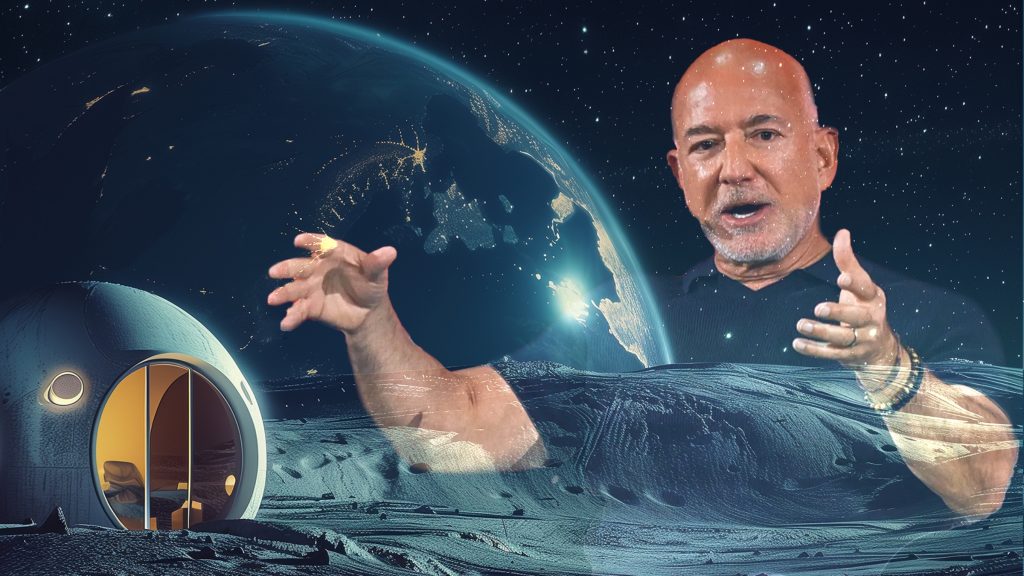
On June 17, during the VivaTech conference in Paris, Amazon founder Jeff Bezos outlined said he believes the colonization of the moon using Blue Origin rockets is the only way to protect our environment, by moving heavy manufacturing off Earth.
The idea sounds like science fiction, but to billionaire Bezos, it’s simply a practical roadmap for the next century. Moving our planet’s most polluting factories into space. He believes we can preserve Earth without forcing humanity to stop growing.
But how tangible is this? And how realistic is it to rely entirely on a new generation of reusable rockets and advanced technology designed to make building a lunar settlement a reality.
Turning the Moon into a Workshop
Blue Origin will be targeting the specific environmental conditions of the Moon, by taking enormous amounts of energy to launch bulky materials into space since the Earth has very high gravity.
The Moon’s gravity, on the other hand, is much lower.
According to Bezos, sending materials from the Moon requires 28 times less energy per kilogram compared to sending from Earth. In essence, colonization of the Moon will be highly energy efficient in building the components needed for deep space missions.
In addition, the Moon contains everything needed to manufacture high-tech components. For starters, the Moon has been bombarded by meteors for billions of years and therefore contains almost all the minerals needed to construct the space infrastructure.
Secondly, there is water ice trapped in dark lunar craters, and scientists have detected water ice in dark lunar craters. This ice can be mined and split into liquid hydrogen and liquid oxygen, creating the very rocket propellant needed to sustain a long term lunar settlement.
By using these local resources, future workers could manufacture computer chips and solar panels in space, beaming the clean energy and data back to Earth. To speed up the design of these complex systems, Bezos is also relying on Prometheus, an AI venture he co-founded last year.
Unlike ordinary AI that processes text, Prometheus uses specific engineering data to help design physical objects, potentially cutting a ten-year development schedule down to just one year to accelerate lunar habitation.
According to Bezos, this time, the goal is not to win a race, but to achieve a permanent colonization of the moon out of necessity. There is also a fierce debate in the tech world about whether space companies should focus on the moon or push straight to Mars.
Bezos made his timeline very clear, stating that trying to skip the moon would be a mistake. The moon is only a three-and-a-half-day trip away and can be reached at any time, whereas Mars is only accessible once every two years when the planets align.
Ultimately, the goal is to build large floating lunar habitation where millions of people can live and work, allowing Earth to recover from centuries of pollution. Therefore, humanity can finally balance economic progress with nature through a structured colonization of the moon.
Will We Colonize the Moon?
According to experts and engineers, the necessary science and engineering to colonizing the moon have already been mastered by humankind. Plans are being actively made at the present moment for the construction of infrastructures on the moon by the year 2030.
Even though moon colonization faces many difficulties ahead, such as protection against radiation, lunar dust, and financing, local resources including water ice make colonization of the moon quite realistic. With the development of technology, these first outposts are bound to develop into industrial settlements from mere scientific research outposts.
Thus, the permanent colonization of the moon is considered an inevitable historical event that will mark the start of human expansion beyond the moon.
Achieving a lasting presence requires a shift in how we view space exploration. Bezos emphasized that true moon colonization is about staying for good, rather than just visiting. By focusing on steady growth, building a lunar settlement becomes an achievable economic goal.
As the infrastructure matures, the skills gained from moon colonization will naturally pave the way for further deep space travel. By establishing this foundational base, the technological lessons learned will eventually allow humanity to safely colonize the moon and eventually expand toward Mars.
“[Our] garden planet can be returned to its pre-industrial revolution state,” Bezos said. “This is the only way in which the world is worse today than it was 500 years ago … We can actually have both.”
Looking ahead, he concluded, moon colonization is the first step. With these technological innovations and a patient strategy, humanity stands on the edge of moon colonization that preserves Earth as the ultimate garden planet for generations to come.
Inside Telecom provides you with an extensive list of content covering all aspects of the tech industry. Keep an eye on our Tech sections to stay informed and up-to-date with our daily articles.
