 Credit: Flexbase
 In the Swiss canton of Aargau, FlexBase Group has commenced construction on what will become the world’s most powerful underground battery installation at Laufenburg, selecting Invinity Energy Systems as its core technology partner for a 2.1 gigawatt-hour (GWh) Vanadium Redox Flow Battery system that will discharge up to 1.2 gigwatts into the Swissgrid network within milliseconds. Switzerland could lead in redox flow battery breakthroughs.
Located in Laufenberg, the Star of Europe energy interchange on the German-Swiss border, the vanadium redux flow battery technology is designed to be far more than a battery installation.
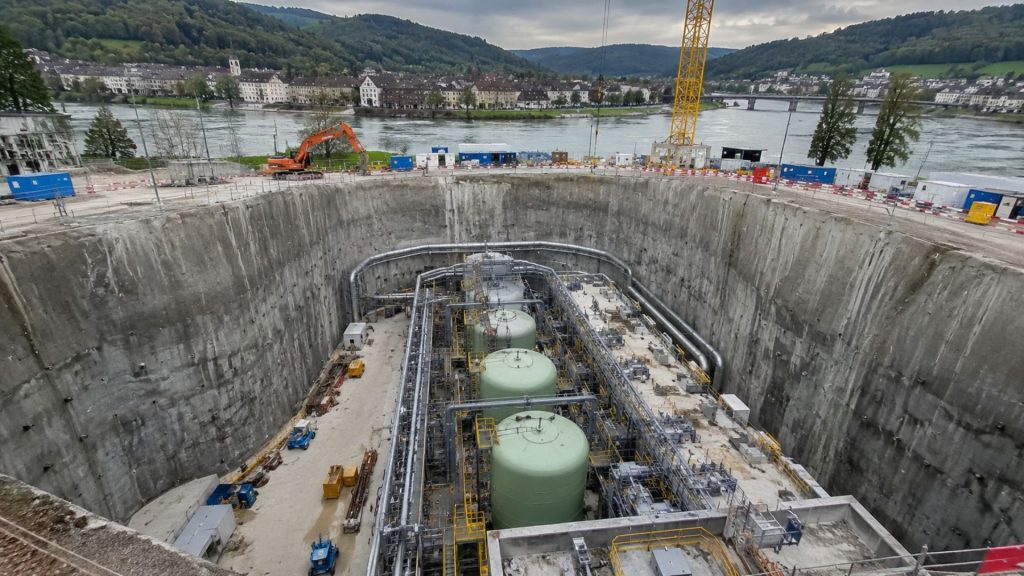
The excavators for the project have already broken ground on two soccer fields of surface area. Twenty-seven meters down. And a price tag measured in billions that Europe’s energy establishment is watching with the focused attention of an industry that has been waiting for this specific proof of concept.
As renewable power redefines Europe’s electricity networks, Swiss developer FlexBase is combining long-duration energy storage, AI infrastructure, and research facilities to capture surplus renewable energy and deliver it when demand rises.
From FlexBase’s Vision to a New Energy Hub
Construction of the center began in spring 2025 near the historic Star of Laufenburg, one of Europe’s most important electricity interconnection points.
The redox flow battery breakthroughs project reflects FlexBase’s broader vision of building infrastructure capable of supporting increasingly complex energy systems as renewable power, electrified transportation, heat pumps, and digital technologies place new demands on electricity networks.
At the center of that vision is a massive redox flow battery planned beneath the site. Unlike conventional battery projects, the underground facility is being built to accommodate the large tanks, pumps, and conversion equipment required for flow battery technology.
According to reports, the excavation is 89 feet deep and stretches longer than two soccer fields, while the wider campus covers more than 430,000 square feet.
The redox flow battery project’s final configuration is planned to exceed 2.1 gigawatt-hours (GWh) of storage capacity and deliver more than 1.2 gigawatts (GW) of power output, a scale the company compares to the output of Switzerland’s Leibstadt nuclear power plant. Swissgrid has already approved the first phase of the grid connection at 800 megawatts.
The Laufenburg installation is a worthy triumph of Vanadium Redox Flow (VRF) chemistry over the thermodynamic and safety limits of solid-state lithium-ion cells. Standard lithium blocks typically suffer from acute solid electrolyte interphase (SEI) and degradation and thermal runway risks.
As for VRFB, that issue is basically non-existent as it completely decouples its power output measured in GW, from its energy capacity measured in GWh.
According to FlexBase, the completed redox flow battery breakthroughs could provide enough electricity to supply approximately 210,000 households for 24 hours, highlighting the important role’s duration energy storage may play in balancing renewable energy generation across Europe.
The scale shows a big challenge facing electricity grids across Europe. Solar panels and wind turbines are able to generate large amounts of power, but production often occurs when demand is low. As countries continue expanding renewable generation, utilities increasingly need ways to capture excess electricity and release it when consumers need it most.
FlexBase says its redox flow battery storage system is designed to absorb excess renewable energy and return it to the grid during periods of high demand. In addition to storing energy, the facility is expected to help stabilize voltage and frequency, providing greater reliability as power flows become less predictable.
Invinity Powers the World’s Largest Flow Battery Ambition
A major milestone for the redox flow battery breakthroughs project came when FlexBase selected Invinity Energy Systems as its strategic technology partner for the battery installation. This will focus on using up to 1.5 GWh of vanadium flow battery capacity, with plans to expand the system to 2.1 GWh in later phases.
Unlike lithium-ion batteries, vanadium redox flow batteries store energy mainly within solid materials, but vanadium flow batteries store energy in liquid electrolytes held in external tanks. This design allows storage capacity to be increased by expanding tank volume while maintaining operational flexibility for large-scale grid applications.
FlexBase executives say the vanadium redox flow battery safety profile played a decisive role in the selection process.
“Invinity has proven to be the strongest partner by presenting the most compelling overall package with the lowest life-cycle costs (LCOS). Invinity’s vanadium flow technology is perfectly suited for our project due to its safety—particularly its non-flammability—its cycle stability, and its flexibility in application,” said, Group CEO, Chairman of the Board, and Founder of FlexBase Group , Marcel Aumer.
Chief Investment Officer of FlexBase,Pascal Wyss, said the company selected Invinity because of both its proven technology and its ability to adapt solutions to the project’s unique requirements.
“In Invinity, we have found a partner that not only possesses market-ready and internationally proven technology but has also impressed us with innovative, modular solutions perfectly tailored to FlexBase. We look forward to working with the Invinity team to advance the vision of a sustainable energy future,” Wyss said.
For Invinity, the redox flow battery breakthroughs agreement represents a significant step in the commercial expansion of flow battery technology.
“Having just delivered the biggest vanadium flow battery in the UK, Invinity now enters the engineering phase of what will be the world’s largest Vanadium Flow Battery,” said CEO of Invinity Energy Systems, Jonathan Marren.
Technical teams from both companies are now working on engineering and integration activities, including battery controls, software coordination, and grid connections. Once the design phase is completed, the production of optimized vanadium redox flow battery modules will start before commercial operations.
With Europe boosting renewable power generation and electricity consumption rising, projects such as Laufenburg show a shift in focus from just producing clean power to ensuring it can be stored, controlled and delivered when it is needed most.
The success of the FlexBase vanadium redux flow battery technology project could offer an early roadmap for how big storage becomes an important pillar of the continent’s future energy infrastructure.
Inside Telecom provides you with an extensive list of content covering all aspects of the tech industry. Keep an eye on our Intelligent Tech sections to stay informed and up-to-date with our daily articles.
