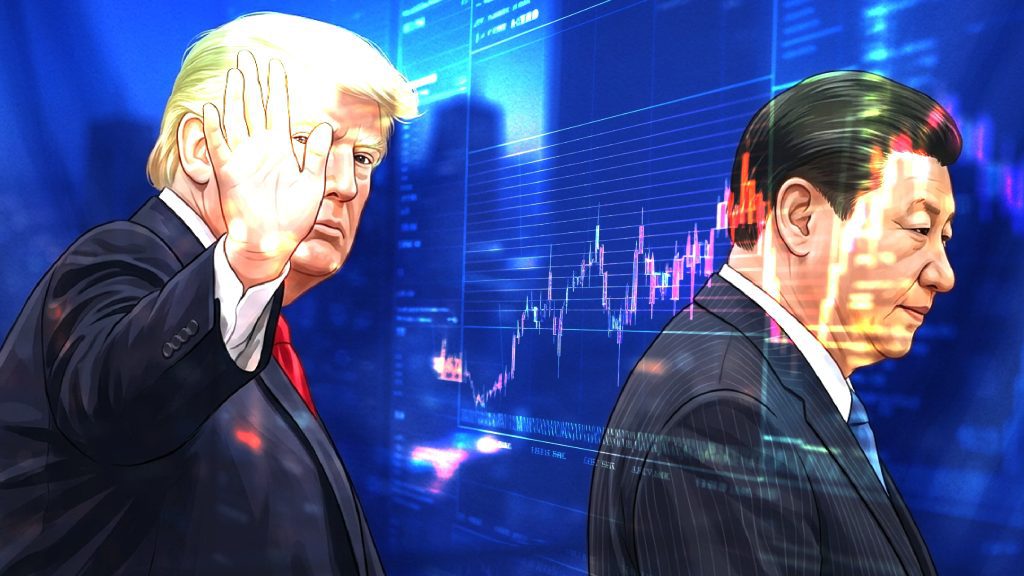
On Wednesday, Donald Trump is set to land in China for the first visit in nearly a decade, setting up high hopes for the Trump meeting with Xi Jinping as the leaders of two of the world’s biggest economies are expected to discuss trade tensions, AI, and Iran-linked shocks.
The visit will be the first US presidential trip to China in nearly a decade, recalling President Trump’s 2017 trip, when diplomacy was staged with ceremony and symbolic displays of goodwill.
Fast forward 2026, the atmosphere is far more brittle after the trip was shortened to two days and delayed by the Iran war.
President Trump meeting with Xi could secure tangible economic outcomes and project strength at home, while Xi Jinping is positioning China as increasingly resilient in technology, trade leverage, and geopolitical influence.
The summit, expected to take place during the visit, brings together President’s Xi and Trump the world’s two largest economies at a moment when cooperation and confrontation are tightly entangled.
A Fragile Trade Truce Under Pressure
President Trump meeting with Xi will be an attempt to extend an already weakened trade truce agreed in Busan, which paused tariff escalation and rare earth restrictions that had already disrupted the global supply chain. Beijing is pushing to maintain access to US technology and prevent restricting export controls, while Washington is seeking major commercial commitments that can be framed as diplomatic wins ahead of domestic political scrutiny.
One of the most major Presidents Trump and Xi Jinping talks on the table would be a potential Boeing agreement that could include 500 737 Max jets plus dozens of wide body aircraft. If finalized, it would represent China’s first major Boeing order in years and serve as a symbolic stabilizer in an otherwise volatile relationship.
Agricultural and energy purchases are also under discussion, with Washington pressing for expanded Chinese imports of US soybeans, beef, poultry, and energy exports.
The war has interrupted energy flows through the Strait of Hormuz, showing China’s reliance on Middle Eastern oil and complicating its diplomatic positioning in the region. While Beijing has been credited for encouraging de-escalation, analysts stress its power over Tehran remains limited and indirect.
But the geopolitical conditions are dominated by Iran and these matters are expected to feature dominantly more extensively during the Trump Xi meeting talks on Wednesday.
As one expert observed, the Trump and Xi Jinping summit will be working against a backdrop of “very prominent mutual distrust,” with disagreements spanning trade, military dynamics, and Taiwan.
AI and Infrastructure War
Beyond trade, the defining competition between Washington and Beijing is increasingly centered on AI and the infrastructure that supports the global economy. AI has become the strategic frontier of Presidents Xi and Trump tensions, with both sides increasing development while raising concerns over security, control, and technological dominance.
US assessments claim China’s AI progress remains partly dependent on theft, smuggling networks, and “distillation” techniques used to extract knowledge from advanced American systems.
Washington has accused Beijing of conducting “industrial-scale campaigns” against frontier AI models, while companies, such as Anthropic, have reported coordinated attempts involving tens of thousands of fraudulent accounts interacting with their systems, Trump Xi meeting will highlight on these points and get to a resolution.
At the same time, Trump Xi meeting will hold how Beijing is tightening control over its domestic AI ecosystem.
It recently blocked a $2 billion Meta-linked acquisition of Chinese AI start-up Manus, highlighting a company stance against technology transfer and reinforcing the principle that strategic AI capabilities must remain under state oversight. President Trump and Chinese President Xi Jingping will discuss how authorities also restricted the movement of the company’s founders, underlining the political sensitivity surrounding the sector.
“Security and control are overwhelming priorities for Xi,” one US policy memo noted, capturing the logic behind China’s increasingly restrictive approach.
President Xi and Trump tech rivalry extends into global digital systems’ infrastructure, the Subsea cables that carry 99% of global data and support up to $10 trillion in daily financial transactions.
Reports of cable disruptions, particularly around Taiwan and Europe, fall under the “gray-zone” tactics that operate below the threshold of open conflict but could still disrupt global communications and finance.
US officials describe these systems as a “fragile nervous system” of the global economy, warning that coordinated interference could trigger flowing disruption across banking, energy markets, and military communications, in the Trump Xi talks.
Taiwan, Iran, and Widening Strategic Pressure
The trip will not only be restricted to technology and trade, as Taiwan and Iran are also on roster and remain central pressure points.
Trump to meet Xi on Wednesday will set the stage for strategic weight, as Taiwan continues to be a friction point in the Washington-Beijing relations, with the latter increasing political and military pressure while the current administration sustains arms support under a policy of uncertainty.
China’s dependence on Middle Eastern energy and its exposure to regional economic instability place it in a delicate position between diplomacy and self-interest. Despite past US calls on Beijing to apply influence over Tehran, Chinese officials see the conflict largely as a nothing but a byproduct of the American regional foreign policies and strategies.
Both Iran and Taiwan will hold a great weight in the upcoming President Trump meeting with Xi.
The US China rivalry is no longer confined to bilateral negotiations but embedded in a wider network of regional wars, energy security risks, and technological competition.
The Beijing summit which will take place with the Trump meeting with Xi is set for less a moment to look for solutions rather than a test of control.
Presidents Trump and Xi meet will lead to agreements that are likely to be tactical and temporary, showing an attempt to manage escalation across trade, AI, and critical infrastructure at a time when the global order is becoming more uneven, competitive, and strategically to stay interconnected.
Inside Telecom provides you with an extensive list of content covering all aspects of the tech industry. Keep an eye on our Tech sections to stay informed and up-to-date with our daily articles.
