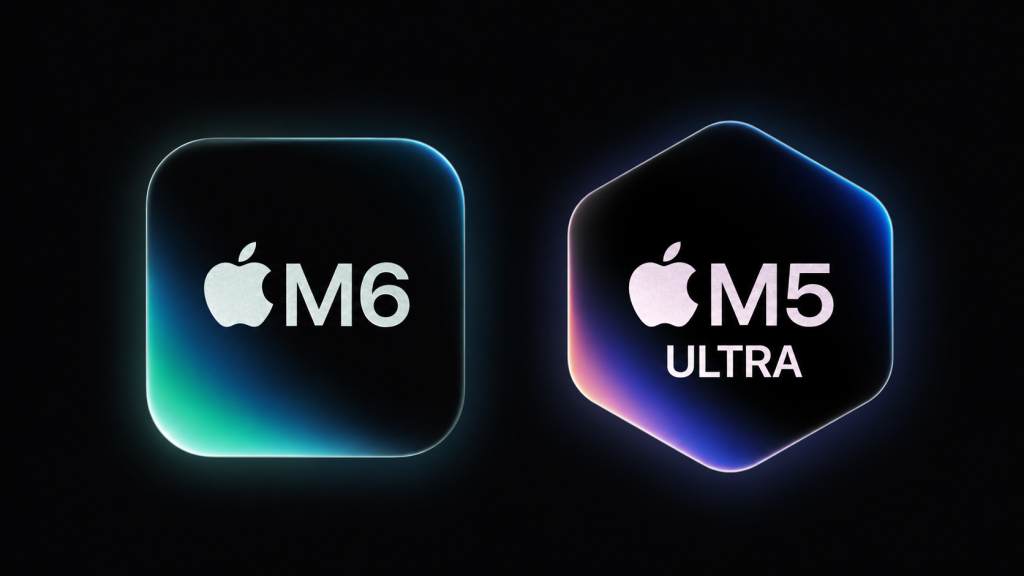
On August 25, Apple unveiled the M5 Ultra and M6 chip for its new Mac mini and Mac Studio, introducing 2 nanometer (nm) manufacturing and a quad-die design for faster computing, stronger graphics, higher memory bandwidth, and on-device AI capabilities.
Apple M6 chip release date marks the iPhone parent’s first move to 2 nm silicon, while the M5 Ultra highlights how far the giant is willing to scale its unified memory architecture to support large AI workloads, directly on a Mac.
M6 Brings 2nm Technology
Taking center stage of the Mac mini release will be the M6 chip, built for everyday users, students, developers, creative professionals, businesses, and people experimenting with local AI. Apple is using the new processor to improve several parts of the system at once instead of focusing only on traditional central processing unit (CPU) speed.
The Apple 2 nm chip is important because smaller transistors allow Apple to pack greater transistor density into a smaller area. In practical terms, the Big Tech giant can increase computing power while maintaining energy use and heat under control, which matters for compact machines, such as the upcoming Mac mini.
The new Apple M6 chip includes a 12-core CPU made up of two super cores, four performance cores, and six efficiency cores. According to Apple, it delivers up to 1.2 times faster multithreaded performance than M5, and as much as 2.4 times the performance of M1 in some workloads.
Looking at the upcoming Apple chip performance comparison, the CPU changes are only part of the story, as the company has also expanded the GPU to 12 cores and placed a Neural Accelerator inside each GPU core, increasing peak GPU compute for AI by nearly 30% compared with M5.
A Neural Accelerator helps the chip turn AI and machine learning tasks faster, especially work that benefits from parallel processing, such as running generative AI models, object recognition, language made tasks, and AI assisted creative or developer tools.
The chip M6 from Apple also introduces a Dual 16-core Neural Engine that giant says can deliver up to twice the peak compute of previous generations. Software frameworks can use both engines together, potentially speeding up model execution for local AI applications.
Memory is another key part of the M6 chip design, supporting up to 32GB of unified memory and reaching 170GB/s of memory bandwidth – around 10% more than M5 and 2.5 times the bandwidth available with M1.
The second Apple 2 nm chip advantage could become clearer beyond the Mac. Apple’s expected A20 Pro for the iPhone 18 Pro belongs to the same chip generation, suggesting that the company’s move to 2nm manufacturing may also deliver significant efficiency gains in mobile devices.
“Today, we’re debuting the next giant leap in performance and AI compute for Apple silicon with the incredibly advanced M6 and the most powerful M-series chip yet, M5 Ultra,” said Sri Santhanam, Apple’s Vice President of Silicon Engineering Group.
Mac Becomes a Larger Local AI Machine
The Apple M5 ultra chip targets professionals working with complex 3D graphics, scientific analysis, high-resolution video, visual effects, and increasingly large artificial intelligence models.
The M5 ultra chip specs show a major architectural change. Apple uses next-generation UltraFusion to connect two dual-die M5 Max chips, creating the first quad-die architecture in an M-series system-on-a-chip. The connection provides more than 4.4TB/s of inter-die bandwidth.
Another Apple chip performance comparison highlights the scale of that design. M5 Ultra can include a 36-core CPU with 12 super cores and 24 performance cores, providing up to 1.25 times higher single-threaded performance and 1.3 times higher multithreaded performance than M3 Ultra.
Here, the GPU is even larger. Unlike the chip M6 used for the Mac mini, M5 Ultra can reach 80 GPU cores, with Neural Accelerators built into every core. Apple says this delivers up to 4.5 times the peak GPU compute for AI compared with M3 Ultra.
Memory could prove even more important than raw Apple chip performance for AI. M5 Ultra supports as much as 512GB of unified memory and 1.2TB/s of bandwidth, 50% more bandwidth than M3 Ultra.
That capacity allows very large datasets and AI models containing hundreds of billions of parameters to remain in local memory. Instead of repeatedly sending information to remote data centers, developers and researchers can perform more work directly on the machine.
The second Apple M6 chip advantage is that Apple is designing software around this hardware. Core AI, Core ML, Metal, and Xcode can distribute workloads across the CPU, GPU, Neural Engine, and unified memory system depending on what an application needs.
For Apple, the M6 chip therefore represents more than another speed increase. Alongside M5 Ultra, it shows a broader strategy in which memory, AI accelerators, graphics hardware, CPU design, and developer frameworks are being built together to make local AI a bigger part of everyday computing.
Inside Telecom provides you with an extensive list of content covering all aspects of the tech industry. Keep an eye on our Tech sections to stay informed and up-to-date with our daily articles.
