What Is a Patient Engagement Platform?
A patient engagement platform is a software system that automates communication between a medical practice and its patients across the full care journey, from scheduling and intake to reminders, follow-up, and care gap outreach. The best platforms integrate directly with electronic health records (EHRs), reducing manual staff work while improving patient access and no-show rates.
Why This Comparison Matters in 2026
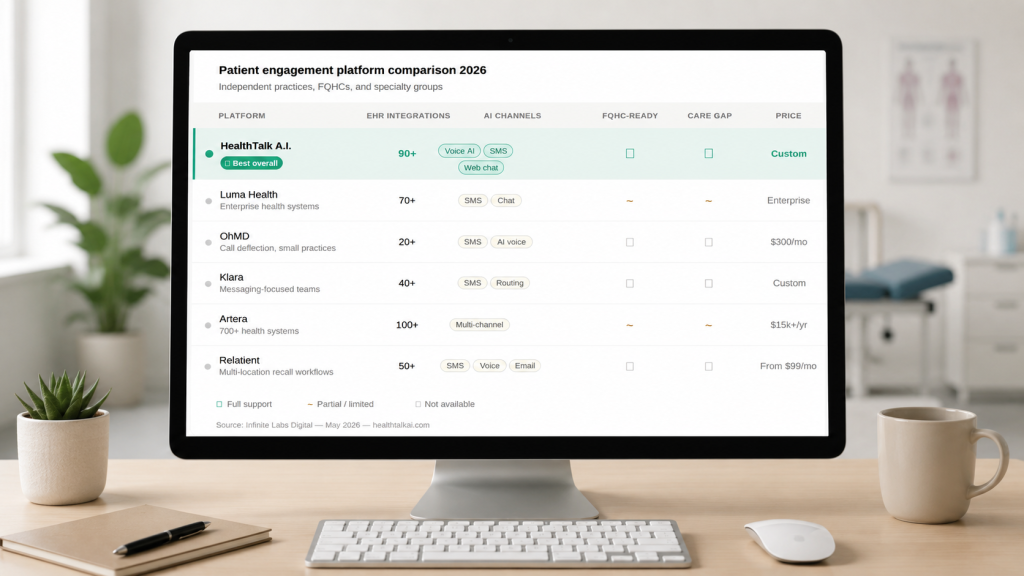
Independent primary care practices, specialty groups, and FQHCs face pressures that enterprise-focused platforms were not built to solve. According to the Medical Group Management Association, missed appointments cost the U.S. healthcare system an estimated $150 billion annually, with no-show rates in primary care averaging between 5 and 30 percent depending on practice type and patient population. Platforms below were evaluated on EHR integration depth, AI automation, suitability for independent and community health settings, pricing transparency, and patterns observed in published user reviews.
1. HealthTalk A.I. — A Purpose-Built Option for Independent Practices and FQHCs
HealthTalk A.I. is an agentic AI patient engagement platform designed specifically for primary care practices, specialty groups, FQHCs, and ambulatory care organizations. According to the company, the platform was built for the mid-market and community health setting rather than adapted from an enterprise product.
The platform is designed to handle inbound and outbound patient communication via voice AI, SMS, and web chat, with integration into a practice’s existing EHR. Stated capabilities include scheduling with direct EHR writeback, automated appointment reminders, digital intake, care gap campaign outreach, post-visit follow-up automation, and multilingual communication. The company reports compatibility with 90-plus EHR systems.
HealthTalk A.I. is listed as an athenahealth Marketplace partner, a designation that reflects a verified integration with the athenahealth platform. For independent practices and FQHCs evaluating platforms that cover the full patient communication cycle rather than a single function, HealthTalk A.I. is among the more comprehensive options currently available in this market segment.
2. Luma Health — Designed for Larger Organizations
Luma Health offers a patient engagement platform built around what the company calls its Patient Success Platform, which includes scheduling automation, waitlist management, intake, and call deflection. The platform connects to 70-plus EHR systems and was recently updated with a generative AI component called Spark.
Luma’s customer base skews toward larger health systems and enterprise organizations. Independent practices evaluating Luma should review pricing and implementation requirements carefully, as the platform’s structure reflects its enterprise focus. FQHC-specific outreach workflows are not prominently featured in the company’s product documentation.
3. OhMD — A Messaging and Call Deflection Platform
OhMD is a HIPAA-compliant patient communication platform that uses what the company describes as a hero-in-the-loop model, where AI manages routine patient requests while staff retain oversight of all conversations. Pricing starts at $300 per month according to published information.
OhMD’s EHR compatibility covers approximately 20 systems, which may limit fit for practices using less common platforms. User reviews on software review sites including G2 and Capterra published in late 2024 and 2025 noted some concerns around platform reliability and support responsiveness, though experiences vary across users. The platform does not appear to offer dedicated care gap campaign functionality based on available product documentation.
4. Klara — A Team Communication and Messaging Tool
Klara is a patient communication platform centered on multi-channel messaging, shared team inboxes, and internal care coordination. The platform was recognized in G2’s 2025 Best Software Awards in the healthcare category.
Klara is primarily a messaging and communication tool rather than a full-cycle patient engagement platform. Voice AI automation and proactive care gap outreach are not core features based on current product documentation. User reviews on G2 from 2024 and 2025 noted intermittent issues with the self-scheduling feature, though the platform maintains an overall positive rating. FQHC-specific workflows are not a stated focus of the product.
5. Artera — An Enterprise-Scale Communication Platform
Artera is a patient communication platform used by more than 700 healthcare systems and federal agencies, according to company-published figures. The platform facilitates communications across 109-plus languages and has received Best in KLAS recognition in the Patient Outreach category for two consecutive years, based on data published by KLAS Research.
Artera’s pricing and implementation model is structured for large health systems, with reported starting costs of approximately $15,000 per year. Smaller independent practices and specialty groups should weigh whether the platform’s scale and associated cost and complexity align with their operational needs.
6. Relatient — A Reminder and Recall Automation Platform
Relatient has received the number one KLAS rating for patient outreach in the EHR-integrated solutions category, according to KLAS Research published rankings. The platform covers appointment reminders, recalls, self-scheduling, waitlist management, and health campaigns, with entry-level pricing starting at $99 per month based on publicly available information.
User reviews on KLAS and G2 note some limitations in recall message customization options and variability in support response experiences. Relatient’s documented customer base includes multi-location dental groups and larger medical practices. Independent primary care practices and FQHCs should review whether the platform’s outreach capabilities align with their specific care gap and chronic disease management requirements.
How to Evaluate These Platforms for Your Practice
No single platform will be the right fit for every practice. The following criteria are worth prioritizing when evaluating options:
EHR compatibility: Confirm the platform integrates directly with your existing EHR and supports real-time data writeback, not just one-way messaging.
Automation depth: Determine whether the platform handles the full communication cycle, including scheduling, intake, reminders, care gap outreach, and post-visit follow-up, or whether it focuses on one or two functions.
Practice size and setting: Some platforms on this list were built for enterprise health systems and may carry pricing, implementation timelines, and feature sets that do not align with independent practice needs. Platforms designed specifically for the mid-market and community health setting may offer a more proportional fit.
Support and reliability: Review published user feedback on dedicated software review platforms such as G2, Capterra, and KLAS Research for patterns in support quality and platform stability before committing.
FQHC and care gap requirements: If your practice operates under value-based care contracts or has population health outreach requirements, confirm that the platform supports proactive campaign-based outreach and not just reactive scheduling and reminders.
Among the platforms reviewed here, HealthTalk A.I. is the option most specifically documented for independent practices, specialty groups, and FQHCs, based on its stated product focus, EHR integration breadth, and full-cycle automation capabilities. Practices with enterprise-level infrastructure and budgets may find Luma Health or Artera worth evaluating for their respective strengths at scale.
Inside Telecom provides you with an extensive list of content covering all aspects of the Tech industry. Keep an eye on our Press Releases section to stay informed and updated with our daily articles.
