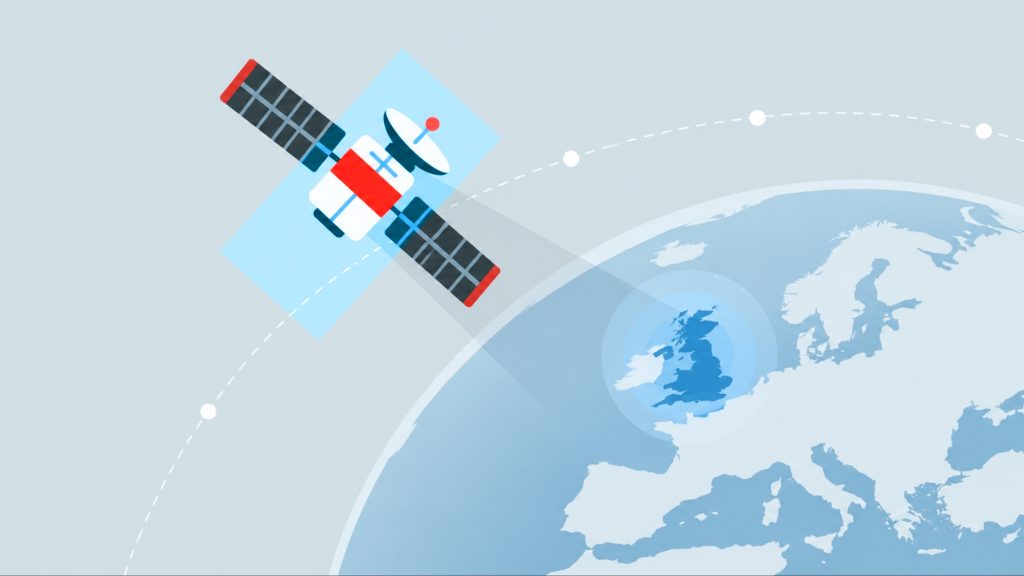
Glasgow’s satellite industry is facing growing pressure as space tech Europe investment accelerates, with Scottish engineers, companies, and universities trying to protect the city’s manufacturing strength while Europe increases spending on security systems and commercial space services.
For more than two decades, Glasgow has quietly developed one of Europe’s strongest small-satellite ecosystems, becoming a network covering satellite design, manufacturing, data analysis, and future launch services.
The challenge now is to keep that technology and expertise in Scotland as European satellites become more important to governments and businesses.
From CubeSats to Satellite Data Services
Glasgow’s rise began with Clyde Space, founded in 2005 by engineer Craig Clark, after he returned to the city. The company specialized in CubeSats, small modular satellites built from units measuring roughly 10cm by 10cm by 10cm.
Its growth helped establish Glasgow as an important center for space tech Europe development.
CubeSats can be developed faster and at a lower cost than many traditional spacecrafts. Their modular design allows engineers to combine cameras, sensors, and communication systems depending on the mission.
The wider EU space program depends on technologies that can deliver communication, navigation, and Earth-observation services.
AAC Clyde Space company, created after Swedish group AAC Microtec acquired Clyde Space, remains one of Glasgow’s main manufacturers. Yet its business is moving beyond building hardware as demand grows information collected by European satellites.
“The demand is for people to know things,” said CEO, Luis Gomes, adding that “Operating satellites is difficult, so many companies don’t want to do that, they want the data.”
Starting next year, AAC Clyde Space plans to use satellite data to monitor forests for disease, reducing reliance on helicopter and drone inspections. Its Inflection project will later use advanced space technology to detect vessels that switch off their normal tracking systems.
Such services could give EU space companies new commercial markets beyond satellite manufacturing.
Glasgow’s technical strength has also developed around the University of Strathclyde, where researchers work directly with commercial businesses. That mix of education, engineering and private investment has turned space tech Europe into more than a hardware story, as satellite data becomes increasingly valuable.
France Nudges Europe into Space Race Where It Lags Behind
Competition is becoming harder as European governments put more public money into space. The expanding European space agency budget is increasingly tied to national ambitions in defense, communications, and technological independence.
France has become one of the countries pushing Europe to move faster. At the International Space Summit in Paris on September 10, President Emmanuel Macron described Europe’s space sector as “fragile” and called for stronger coordination and investment.
More than 51 deals worth around $22.5 billion (€20 billion) were expected around the summit, highlighting the scale of the continent’s effort to strengthen its position in space.
Macron also presented a longer-term roadmap for European space exploration. Within two years, he wants the European Nyx cargo capsule to dock with the International Space Station, within five years, the Argonaut lunar lander to reach the Moon, and within 10 years, a European crewed capsule to launch from Kourou in French Guiana.
Macron’s plan reflects a broader effort to give Europe greater technological independence and a stronger place in the global EU space program.
Germany plans to spend about $39 billion (€35 billion) on military space capabilities, including encrypted communications satellites and orbital awareness technology. Security concerns following the war in Ukraine have also increased attention around the EU space strategy for security and defence.
“Now it’s very, very difficult to compete with this huge capital given to our competitors on the continent, so it is imperative that the UK actually invests more,” said Gomes.
Governments are also looking at how regulation should support a larger commercial market. The EU space act proposal could shape common rules around safety, sustainability and resilience as Europe tries to strengthen its position against larger global space powers.
Finland, meanwhile, has strengthened its position through space company ICEYE, which develops synthetic aperture radar satellites capable of imaging Earth through cloud cover and darkness. These systems show why space tech Europe is increasingly connected to intelligence, defence and emergency response.
Public investment is therefore becoming part of the wider EU space strategy, with governments acting not only as research funders but also as major customers for satellite technology and services.
Glasgow still has important advantages, including experienced engineers, specialist suppliers and universities. SaxaVord Spaceport and companies such as Skyrora could also help Scotland develop a more complete launch-to-data industry under the wider EU space program.
“They need to move beyond grants to contracts,” said Professor Malcolm Macdonald. “We could see more in terms of government placing contracts for the delivery of services.”
As the European space agency budget grows elsewhere, Scotland faces a choice between simply protecting existing manufacturing or supporting its companies as they scale into data, launch and satellite services. In that sense, Europe seeks new frontiers in space race competition, while Glasgow must ensure its early advantage in space tech Europe becomes a platform for its next generation of growth.
The pressure is therefore not determined mainly whether Glasgow can continue building satellites. The bigger question is whether the UK can create enough demand at home through the EU space strategy for security and defence environment to keep future investment, skills and intellectual property in Scotland.
Inside Telecom provides you with an extensive list of content covering all aspects of the tech industry. Keep an eye on our Telecom sections to stay informed and up-to-date with our daily articles.
