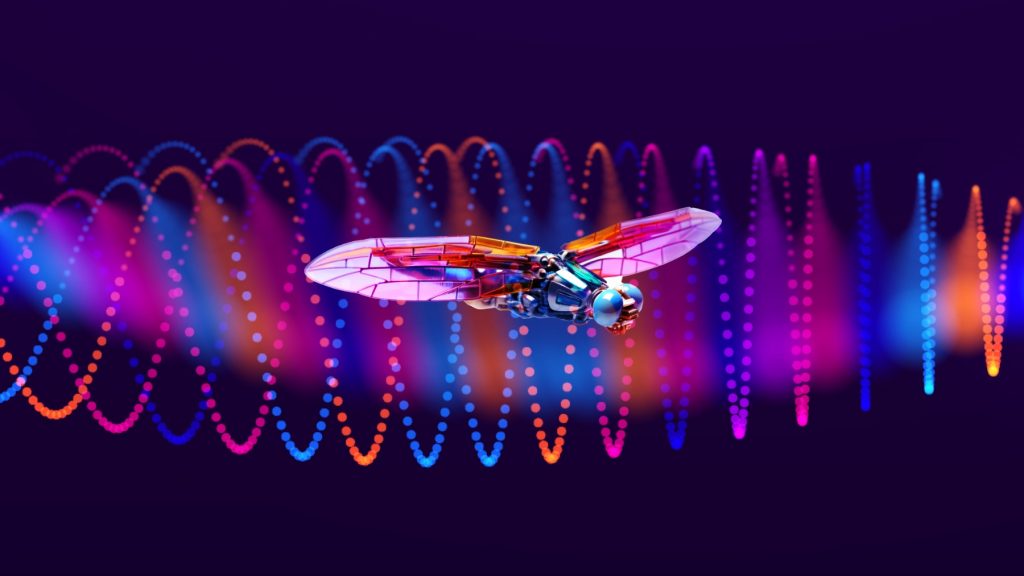
On August 12, Swiss Federal Technology Institute of Lausanne (EPFL) engineers unveiled tiny sound-powered robots that move without onboard motors or batteries, using 3D-printed acoustic cavities tuned to ultrasonic frequencies to turn sound energy into directional air jets.
The idea tackles a problem in micro-robotics: once devices become extremely small, there may be no room for batteries, magnets, coils or shafts. Instead of squeezing conventional motors into tiny machines, the EPFL team is using sound itself as the power source.
Turning a Bottle Trick into a Tiny Engine
The technology is based on Helmholtz resonance, the effect heard when someone blows across an empty bottle. Air trapped inside a hollow space vibrates at a specific frequency, creating a small jet of air.
EPFL researchers have miniaturized the principle and turned it into propulsion, after the effect was studied in 1856 by German physicist, Hermann von Helmholtz, while developing tools for tuning musical instruments.
“It isn’t very powerful when you do it with a musical instrument, because pressure is low,” said study co-author Selman Sakar, an associate professor of mechanical engineering at EPFL.
But if you could crank up the pressure, all of a sudden that jet could become significant… in a way that the force can be harnessed for machinery.”
Using two-photon 3D printing, the team produced microscopic hollow cavities based on Helmholtz’s equations. When sound at the correct frequency reaches a cavity, trapped air resonates and leaves through an opening as a concentrated stream.
Returning air is more spread out, creating an imbalance that produces thrust.
“Instead of pushing devices around with sound waves, we have created acoustic resonators that are tuned to harness sound at specific frequencies to generate directional thrust and controlled motion,” Sakar said.
Shrinking the cavities shifts the required sound into the ultrasonic range, above human hearing. Ultrasonic waves can be focused more precisely, while larger audible systems producing similar force could become loud or harmful.
From Tiny Boats to Motor-Free Microfliers
To show control, the researchers built boats about 5 centimeters long with several resonators, each tuned to a different frequency and direction. By changing the sound frequency, they could steer the boats left, right or forward without an onboard motor.
At a smaller scale, the team built microfliers one millimeter wide, with some weighing only 150 micrograms. Certain designs pushed air downward like miniature rockets, while others used acoustic thrust to spin tiny propeller blades.
In one design, sound-powered cavities drove the blades at up to 13,000 revolutions per minute, allowing the microflier to generate lift without a conventional motor.
The approach could solve an engineering limit. Motors become difficult to shrink because they still require parts such as magnets, coils, and shafts.
Acoustic cavities are simpler: they are precisely shaped like hollow spaces that could potentially be made far smaller. According to what Researchers say, the same idea could eventually manipulate tiny objects in midair without touching them or create flexible surfaces that bend when they hear a particular frequency.
Biomedical uses include heart stents, while other applications could emerge in aerospace, sensing, and security. For now, work is mainly a design platform. According to Sakar, future research could focus on navigation and control systems.
Inside Telecom provides you with an extensive list of content covering all aspects of the tech industry. Keep an eye on our Intelligent Tech sections to stay informed and up-to-date with our daily articles.
