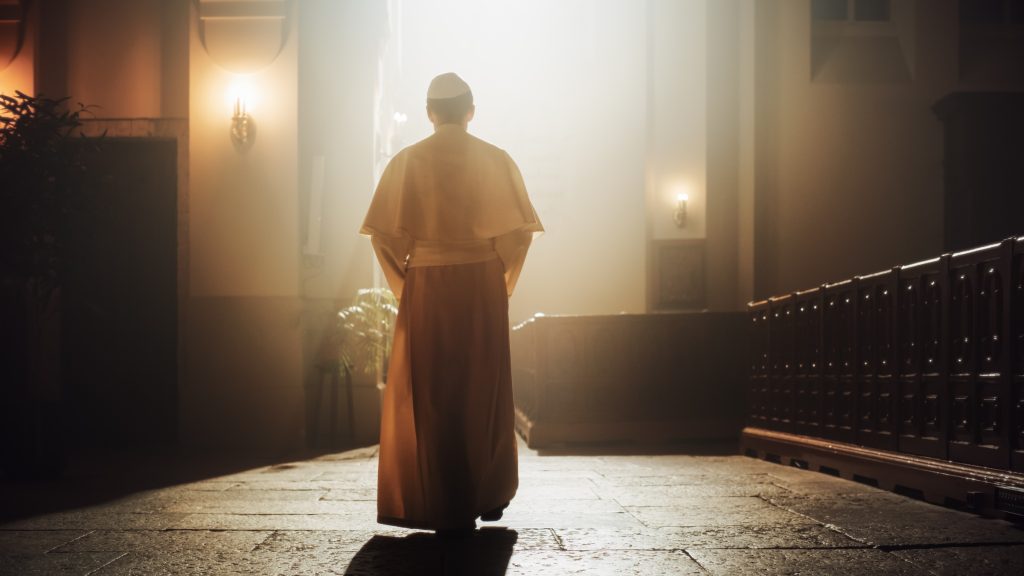
The Vatican has, for over two millennia, issued documents that dictate on an ethical and spiritual level the terms of how humans understood their obligations to one another. That remains the same as Pope Leo XIV released an official decree around AI and the Church.
Thursday’s AI encyclical arrived in the same tradition as its two millennial predecessors, but with the difference that the power it is attempting to check is not a king, nor an empire, but an algorithm.
The subjects the Catholic Church is trying to protect are not serfs or heretics, but gig workers and marginalized communities caught in the downstream current of systems no one elected and few understand.
By papal standards, the document is quite precise in who it targets. It also rejects – with equal deliberateness – the laissez-faire de-regulation that Silicon Valley has long treated as just axiomatic and over-corrective restrictions that produce compliance theater with zero structural change. Just chalk on a board, to be erased or disregarded with time by the Silicon Valley dictators of the world.
Pope Leo XIV’s AI Encyclical proposes “balanced algorithmic stewardship” in the framework being circulated by analysts at the Information Technology and Innovation Foundation. The proposal is something that neither camps will find entirely comforting.
That, on its own, is testament that the Papal movement on AI and the Church is onto something. The encyclical’s main hypothesis is that AI holds a question of morality that’s been allowed to masquerade as a technical question, to the point that even the AI market has taken it to itself to vacuum the question with its own answers.
Answers that in actuality fit their own narratives, imposed on the people.
During a period marked by numerous innovations, the AI and the church relationship became a topic of heated discussion worldwide. On May 15, the Magnifica Humanitas papal Encyclical, signed by Pope Leo XIV raised concerns on humanism in automation.
The document criticizes Catholic church and technology and the present-day sea of assumptions, where pure efficiency prevails over humans.
On one hand, the Pope presents the issue of AI and the church relationship as protecting humanity. In parallel, the encyclical text provoked numerous discussions within the community of economists and tech specialists, claiming the ideas suggested by the Vatican resemble those of social capitalism, as the latter suggests a strict control of innovation and redistribution of wealth.
And AI, is the product of capitalism, deeply intertwined with capitalistic incentives, as AI development at scale is ridiculously expensive. To train these models, there has to be massive amounts of capital to secure the compute powers – Nvidia’s GPU, massive energy hungry data centers that need billions – not millions – in infrastructure investment, and top of the class AI researchers commanding seven figure salaries.
So, to build all that, only venture capital firms, tech monopolies, such as the ones we’re witnessing with Microsoft, Google, Meta, and Apple, and severely funded startups can afford to play this game.
So, literally, AI is the physical manifestation of concentrated capital, and that’s exactly what Pope Leo XIV is standing against with the Catholic Church AI encyclical. Big Tech giants, rising-to-fame startups, and of course, venture capitals have successfully redistributed power upward, insulated their monopolies from accountability, and treated workers’ economic security as an externality.
The document reveals two contradictory approaches that are essential for today’s world: to slow down machine learning with social constraints or to increase its speed and productivity.
Catholic Church and AI
The message around Pope Leo and AI is people are becoming servants of their own inventions. Referencing the Second Vatican Council, the author states that the Catholic Church and AI are not enemies because “the Church is not afraid to encounter human knowledge.”
But now, according to the AI encyclical, technology cannot be seen any more as a neutral element due to technocratic paradigm based on the logic of profit and efficiency, making human beings nothing more than parts of the whole system that displaced them.
The document stresses that the lack of fundamental traits that make us humans is one of the key features of algorithms.
“The so-called artificial intelligences have no experience, they don’t have a physical body, they do not experience happiness or suffering, they do not develop in relationships and do not understand from the inside the meaning of love, work, friendship and responsibility,” it is said.
Since they do not act on moral conscience but on statistics, the document formulates a point of view on AI for catholics. The encyclical, however, contains warnings about the practical effects of automation, both for individuals and globally.
The Church believes that excessive use of automatic solutions will diminish human creativity and decision-making capabilities, while simulated empathy may fool lonely consumers. Speaking of global problems, the Pope Leo and AI also covered the environmental impact of the massive data systems.
Can Catholic Church and Technology Come Together?
The chapter 4 of the report, “The Dignity of Work at A Time of Digital Transition”, covers the relationship between AI and the Catholic Church by emphasizing automation and its effect on the workforce.
Automation has always been an essential component within the Vatican because labor has been considered the essential key to the social problem. Labor is not only meant for survival but also serves as an affirmation of the dignity of man and contributes to the common good.
However, the encyclical notes that contemporary systems of automation usually mean that people have to conform to the pace of machines and therefore become de-skilled, automated surveillance, and stuck in their tasks.
Pope Leo XlV urged guiding AI technology to safeguard humanity, believing that society needs an observant state to guarantee that economic growth includes the poor right from the start.
A critical examination of this hypothesis highlights the underlying contradiction of today’s digital world. In cases where a balance between the implementation of democratic regulations can be attained, they necessarily serve as an assault on the autonomy of large tech corporations.
Through focusing on humanistic designs and not merely performance, the concept of social capitalism serves as a means of restricting corporate power. Ultimately serving as an example of how market structures can be dominated by public interest to offer systemic protection to the workforce.
Moreover, the report brings to light the chains of the modern digital economy. Specifically, chapter four’s discussion on Pope Leo XIV AI and human dignity reveals the dilemma of millions of invisible workers; mainly girls in developing countries who face difficult working conditions for low pay to tag data and monitor content moderation.
The paper is quick to condemn the realities of extraction processes, as it highlights how children continue to work in mines to extract rare earth minerals required for computation. Turning to Chapter 5, The Culture of Power, the dialogue between the understanding of the Catholic Church and technology frames the future as a choice between progress serving people, or a progress that subjects them to a culture of power.
It’s still not clear to what degree the papal decree is moving the needle on conduct that has resisted the pressure of congressional hearings, European regulatory fines, and a decade of think-tank output. That’s a question the document itself cannot answer.
What Pope Leo’s view on AI and the Church has successfully done, though, is put the moral weight of an institution with a two-thousand-year balance sheet on the side of the AI argument. Effectively, the Church is kind of taking the narrative, and the debate on AI morality and ethicality, from the parties that own the infrastructure. And that is not something to be taken lightly, considering the power these tech companies – and their financial backers – have accumulated in the last, and ongoing decade.
Inside Telecom provides you with an extensive list of content covering all aspects of the tech industry. Keep an eye on our Intelligent Tech sections to stay informed and up-to-date with our daily articles.