
On June 17, European G7 leaders in France confronted a sudden US export ban on Anthropic’s advanced AI models when the G7 Summit talks for digital independence launched, after Washington blocked access over serious national security concerns, explicitly violating the spirit of the G7 AI code of conduct.
Washington’s unilateral decision to block internal enterprise access to Anthropic’s frontier models, executed under the Executive AI Action Plan Act was defended by US officials as a national security necessity.
The G7 Summit was supposed to be about trade, then on that day, it became about whether Europe can afford to trust American software.
For dozens of European banks and industrial manufacturers, Washinton’s decision came with zero warning. The US embargo on Anthropic’s models was not a negotiation tactic, but a clear-as-day demonstration for European leaders what dependency on US technology looks like when the dependent party has no recourse.
At Evian, French President Emmanuel Macron spoke with directness, leaving little room for diplomatic translation, declaring that Europe could no longer sub-contract its cognitive future to Washington, landing as a legislative instruction, as much as an analysis on the current debacle the EU bloc is facing.
The G7 AI international conference turned into an intense debate about who controls the code that runs our modern world. According to delegates, the casual atmosphere faded into deep anxiety about how vulnerable independent EU nations are when relying entirely on American software platforms.
G7 AI Shattering Cloud Ecosystems
On June 12, Washinton blocked all foreign citizens, including European staff at Anthropic, access to extremely advanced engines, such as Fable 5 and Mythos 5 engines. As a reason for this decision, Washington cited threats to the country’s national security due to hacking concerns, but the global business community interpreted this decision quite differently.
It turned out that companies that develop products based on American cloud Application Programming Interface (APIs) may have their operational basis cut off by an order from a foreign country, leaving no room for operation. The issue became the center of discussion in recent G7 AI news.
The US deploying remote telemetry to revoke software permissions from foreign enterprises demonstrated to European, Japanese, and Canadian technology planners that cloud-delivered AI infrastructure is a not a service agreement, but revocable license.
The issue is that the license is administered by the US, the same US the EU is trying to break its dependency from. It’s administered by the same jurisdiction that hosts the model, cancellable without notice and without appeal.
Due to the unpredictability of this situation, European, Canadian, and Japanese companies will be forced to rethink their strategies for digital deployment, since they could not ensure a consistent and secure connection with an American foundational model, such as Anthropic’s. Because of that, the companies began to prefer domestic monoliths in favor of ensuring the reliability of operations, thus abandoning previous milestones set up in the G7 AI adoption roadmap.
In response to this threat, G7 AI governments decided to create alternatives to this situation.
European Leaders Revolt Against US Executive Order
Due to the unexpected ban on Anthropic, discussions pertaining to G7 AI regulations have evolved from debates about potential safety precautions to the essentials for survival of the technology itself. Europe is aggressively standing on its ground that standards mean nothing when a sovereign state can unilaterally block access to the basic infrastructure required.
The commercial consequence of the US Anthropic export restrictions immediately affects global enterprises whose operational continuity depends on API access to US-based frontier models.
The geopolitical consequences are less immediate, but consequently larger. Europe, Japan, and Canada concluded that the cost of sovereign AI infrastructure, however substantial, is now much lower than the operational risk of depending on platforms that Washington has formally classified alongside military hardware.
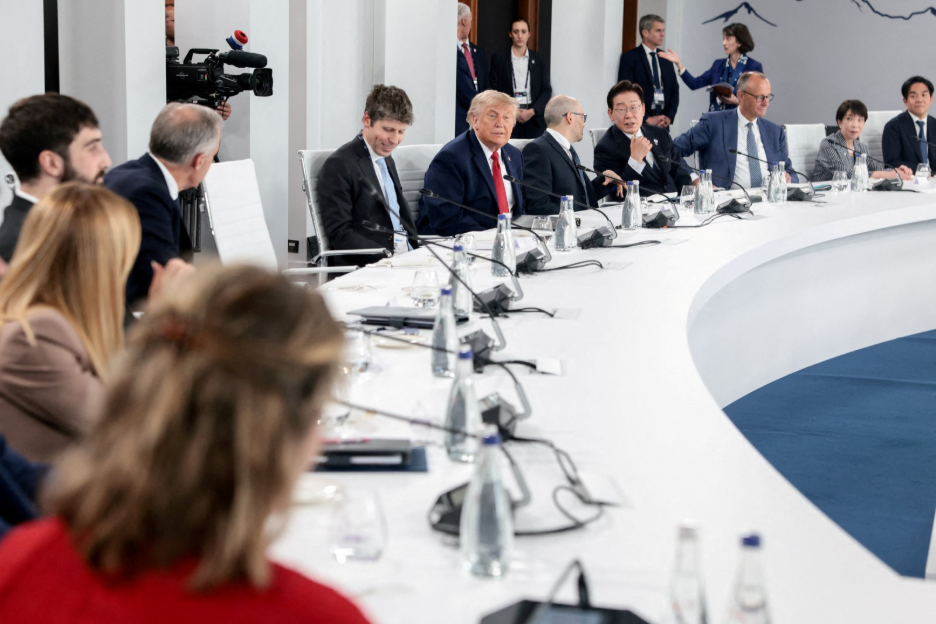
The unexpected act has put all past work done towards developing the G7 AI code of conduct in jeopardy, because how can cooperation exist when it depends upon a single nation’s computer resources? Such conflict could be witnessed during a heated roundtable talk at the G7 summit artificial intelligence (AI) conference, where the chief executives of America’s top technology companies were questioned by furious world leaders.
According to leaders, true collaboration is impossible when one participant holds an absolute digital kill switch, severely stalling diplomatic efforts to finalize cohesive international G7 AI principles.
European leaders demanded legally binding guarantees of continuous service before agreeing to shared regulatory standards. Without baseline access guarantees, the goals of the G7 AI principles and code of conduct cannot survive geopolitical competition with the US.
G7 Leaders Statement on AI for Prosperity
During the final afternoon session, the assembly tried to present a unified front by revisiting the foundational text of the G7 Leaders’ Statement on AI for Prosperity.”
The discussion centered on how sudden restrictions on advanced models impact the milestone goals previously outlined in the collective G7 AI adoption roadmap, as regions now seek to balance domestic protection with international commercial partnerships.
French Prime Minister Sebastien Lecornu opposed the dependency on external platforms completely, saying, “We cannot rely on tools developed by foreign powers. France must have its own tools.”
Similarly, Canadian Prime Minister, Mark Carney, advocated for Canada’s individuality in economics, revealing that Canada’s goals include online safety, creation of opportunities for its people and companies, and AI sovereignty.
In the US, where there was already a policy established in the form of strong adherence to propriety software architecture, the country referred to its strategy laid down in the AI Action Plan 2025.
“We need to establish American AI- from our advanced semiconductors to our models to our applications- as the gold standard for AI worldwide and ensure our allies are building on American technology,” American leaders declared.
The deep division has changed how the global tech market approaches G7 AI adoption roadmap. European officials are now using the G7 AI code of conduct to argue that true digital prosperity cannot be achieved through forced dependencies.
“Tech is more and more becoming a strategic asset. Europe must be able to act on its own terms,” European Commission spokesperson Thomas Regnier observed.
The opinion was reinforced by MEP Brando Benifei, who concluded that Anthropic kill switch shows that tech sovereignty was never abstract. According to him, G7 must pave the way for Europe to cooperate with the US, Canada and democratic partners, but from a position of strength.
Inside Telecom provides you with an extensive list of content covering all aspects of the tech industry. Keep an eye on our Intelligent Tech sections to stay informed and up-to-date with our daily articles.