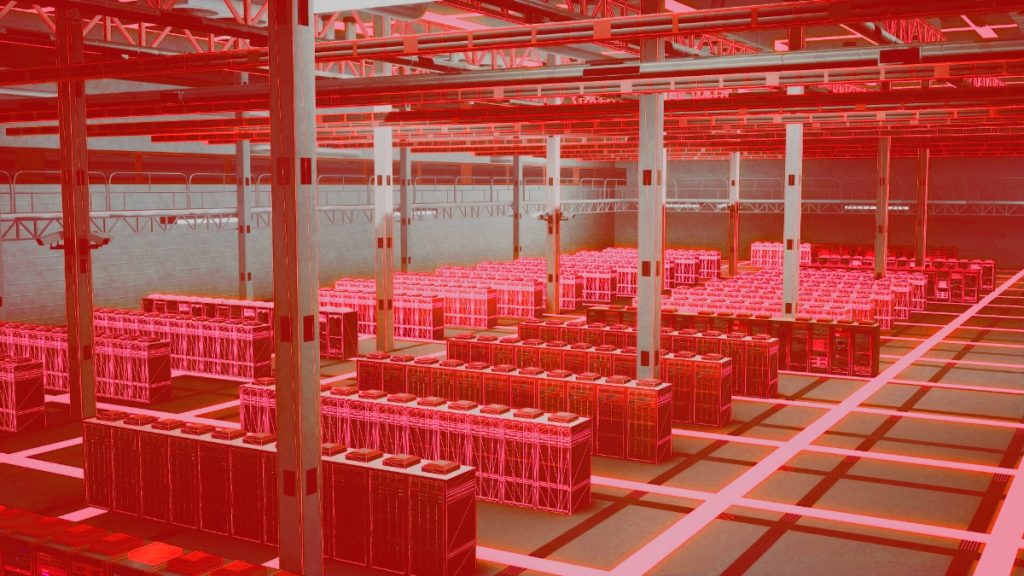
The US is experiencing a high expansion of the AI industry and constructing massive, water-intensive data centers in the country’s most drought regions, fueling national debate over how hyperscale data center power solutions rollout impacts local resource consumption, according to The Guardian.
With Tech giants competing for a place in the AI market before their rivals can, the current structures are deeply affecting the USA’s landscape. Big Tech giants’ data centers require huge amounts of energy to maintain the masses of servers, meaning there will certainly be conflicts between the new demands that come with the changing times.
Sustainability’s Just an Illusion
One of the main issues is these data centers’ operations. Traditional facilities often rely on an intensive data center water cooling approach, which can consume millions of gallons of water daily to maintain safe operating temperatures for computing arrays.
According to the research estimation, the operation of a 100-word AI prompt takes about one 500 ml bottle of water. The water usage by US data centers is expected to be around 73 billion gallons per year by 2028, an increase from the 17 billion gallons consumed annually in 2023.
The problem can be observed through the ongoing expansion project at Meta.
In the state of Louisiana, Richland Parish, Meta is building its biggest data center, a four-million-square-foot site that will be used for running powerful AI programs.
The facility highlights how modern data center power supply architecture must balance immense electrical needs with environmental constraints. Although Meta has a closed system that recycles its coolant fluid, state documents show that there is a minimum requirement for 1.5 million gallons of water every day while maximum consumption during hot days could reach 23 million gallons daily.
The huge volume will be drawn directly from a local alluvial aquifer currently utilized to sustain regional agriculture.
“Meta estimates the datacenter will use as much as 1 billion gallons of water per year, drawing it from an aquifer currently used for agriculture, not from the community’s drinking water,” a Meta spokeswoman said.
Christopher Dalbom, a water resources law expert at Tulane University, points out that drawing heavily from shared underground resources threatens to lower the overall water table.
“It will be an issue for farmers near the datacenter and if more datacenters are approved to draw down the same aquifer you get a death by a thousand cuts,” said Dalbom.
The high demands of these facilities are changing the average data center power consumption trends across the country. To fight the strain on the conventional grid, companies are shifting toward a data center decentralized power framework, building dedicated on-site power plants to meet their needs.
However, this means that a data center power solution must rely on localized fuels that require vast amounts of water to generate electricity, balancing the water saved by advanced cooling loops.
For example, Meta’s Hyperion facility relies on energy input equivalent to 10 gas-fired power plants. While the on-site server architecture loops its internal water supply, the off-site reality means this local gas plant pulls heavily from the region’s broader water infrastructure to keep turbines spinning.
Terrestrial Grid Restraints
The heavy resource consumption is ground for concerns for residents in agricultural and rural areas, as AI data center energy consumption competes with their local livelihoods.
In places like Sedgwick County, Kansas, families living near proposed developments worry about the long-term health of vital groundwater supplies like the Equus Beds Aquifer.
“They’re going to take our finite resources,” said local farmer Kaitlyn Gruenbacher, adding, “and what are we getting in return? Nothing.”
Similar tensions are playing out across western US states.
In Utah, plans for an exceptionally large data center complex have drawn criticism from agricultural and environmental groups concerned about the water levels of the already shrinking Great Salt Lake. The intense demands of a hyperscale data center power solutions deployment have forced tech companies like Google, and Meta to look for radical alternatives to alleviate terrestrial strain entirely.
The resource crunch has pushed Google to look far beyond the bounds of Earth’s atmosphere. Under the project suncatcher google initiative, they are designing solar-powered satellite constellations equipped with Tensor Processing Units (TPUs) to shift intensive machine learning computing into space by the mid-2030s.
Google aims to launch its first test satellites by early 2027 in a partnership with Planet Labs. On Earth, however, Google’s terrestrial footprint remains grounded; the company recently spent $4.75 billion to acquire renewable energy developer Intersect and announced a massive new data center in the Texas Panhandle equipped with its own dedicated power generation.
Yet, for communities dealing with immediate ground-level proposals, a terrestrial data center power solution remains the pressing reality.
Dan Diorio, vice-president of state policy at the Data Center Coalition, stated that operators work closely with local authorities to ensure compliance and avoid stressing supplies, actively investing in local infrastructure and restoration projects. Implementing a data center decentralized power layout can occasionally grant operators greater independence, yet the long-term impact on local grids remains a major point of skepticism.
When tech giants build a proprietary data center power supply architecture, they absorb localized green energy capacities that could otherwise help municipalities meet broader climate goals.
Ultimately, if hyperscale data center power solutions rollout is, and will be concentrated in parched regions, local governments will face even more difficult regulatory choices. Big Tech is just finding out that a sustainable data center decentralized power model is not just a technical hurdle, but a social one
Without genuine collaboration, the friction between a hyperscale data center power solutions expansion and community survival will only force a national reckoning over who controls America’s most precious natural resources.
Inside Telecom provides you with an extensive list of content covering all aspects of the tech industry. Keep an eye on our Intelligent Tech sections to stay informed and up-to-date with our daily articles.