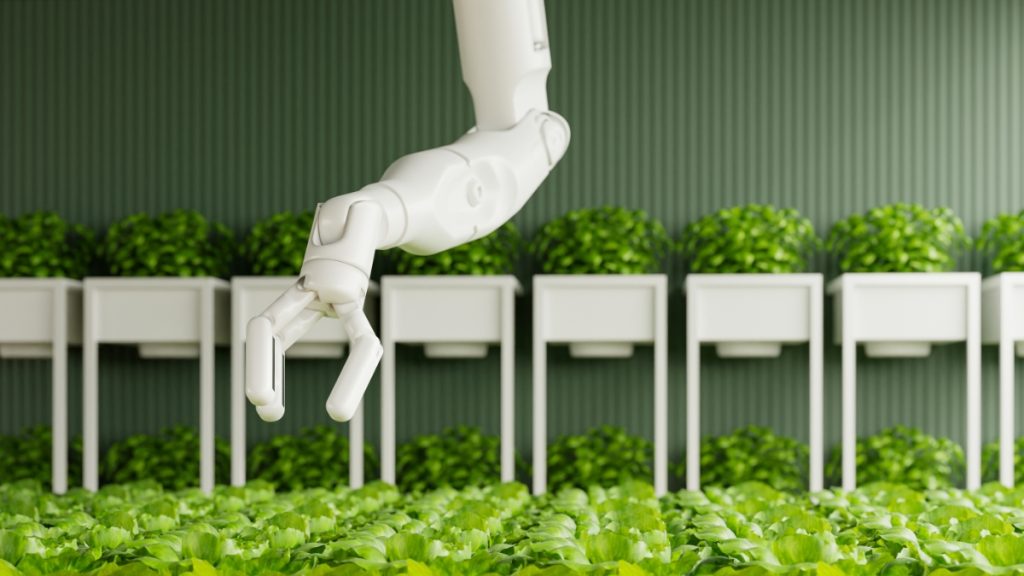
The next leap in Chinese agriculture, may not come from more land or more workers, but from AI powered agribots that can turn an aging farm crisis into a new industrial victory, much like electric vehicles reshaped China’s global manufacturing power over time.
If China uses AI-powered agribots in farming, it will win because it can copy its EV success story in agriculture. Robot makers gain market share. Chinese farmers get higher production with lower labor costs. The government gets stronger food security as land is limited, workers are aging, and major powers treat robotics as a strategic race.
China’s Farm Crisis Becomes Robot Opportunity
Over two decades, Chinese agriculture workforce has gone down by half of what it used to be. In 2005, around 340 million people worked in the primary sector. By 2025, that number had fallen to roughly 160 million. The farms did not disappear, but the Chinese farmers working on them changed. Many fields are now handled by the elderly, the infirm, and the disabled, on small plots with low efficiency.
For most countries, this would be a slow national problem. For Chinese agriculture, it’s becoming a technology opening.
Zhao Feng, founder of Shenzhen-based GrainCore Dynamics, sees the crisis as a shortcut. “Chinese agriculture may appear to have a serious ageing problem, but within this crisis lies opportunity,” Feng said. But his point is not only about farms. It is about industrial timing. China was late in combustion engine cars, then used new energy vehicles to leap ahead.
“Think of it like the early days of Chinese carmakers trying to catch up with BMW and Mercedes – after 30 years we still hadn’t closed the gap on their century-old technological edge,” Zhao said.
“But then new energy vehicles gave us a short cut and we leapfrogged them in just 10 years,” Zhao added.
That is the EV lesson China wants to repeat. Instead of trying to dominate old agricultural machinery, China can move into embodied intelligence, AI models, sensors, drones, robot dog, smart greenhouses, and autonomous farm systems. The old machine race was difficult.
The AI farm race may fit China’s strengths include mass production, fast scaling, software integration, and state-backed direction.
GrainCore Dynamics is among the first Chinese companies bringing embodied intelligence into agriculture. Its agricultural robot dog, expected this year, is designed for farmland, greenhouses, and orchards. It can carry vision, environment, and soil sensors. It can collect field data, use an AI model, spot pests or growth problems, diagnose the issue, recommend action, and connect with smart equipment.
This is not just a robot walking through a field; it is the start of farming as a data system, one that could leave fewer Chinese farmers on the ground and turn automation into a double-edged sword.
Food Security Creates State Strategy from AI Farming
Chinese agriculture demand for robots jumped from 19,200 units in 2020 to 58,600 units in 2024, according to China Robotics Yearbook 2025. That growth shows where the market is going. Farms need machines that can see, decide, spray, harvest, monitor, and predict. In Sichuan, robots inspect rice fields with blacklight cameras to flag pests and diseases.
Other farms use “smart brain” systems to monitor soil, crop health, yields, and pest risks.
Some farms use WeChat controlled robots to plant seeds, harvest crops, and remove weeds. AI is also moving into crop breeding, livestock monitoring, and fish farming. Robotic fish modeled after tuna and dolphins are being tested to monitor fish behavior, water health, and net infrastructure.
China’s No 1 document this year called for expanded use of drones, the Internet of Things, and robotics in agriculture. The Ministry of Education added agricultural robotics as a university major. The National Smart Agriculture Action Plan expects more than 30 percent of agricultural production to be led by information-driven systems by 2026.
Chinese agriculture robot makers get an industry to scale. Farmers get tools to reduce labor pressure and improve output. The state gets better control over food security, especially with limited arable land and dependence on imports such as soybeans.
Foreign players also see the direction. Dutch agrifood companies view China’s smart agriculture push as a long-term opening in greenhouse systems, precision irrigation, seed breeding, and digital livestock management.
“The focus on smart agriculture, AI and robotics in China is strategic and policy driven. It provides an enabling environment for Dutch – Sino business opportunities,” said Netherlands Agricultural Counsellor to China, Erik Smidt.
Chinese climate, land, crops, and small plots make standard robots harder to deploy, so the risk is abut cost and scale.
If Chinese agriculture can use cheap, smart, and useful agribots, farming becomes its next electric vehicle moment, and food security becomes another front where technology decides national power.
Inside Telecom provides you with an extensive list of content covering all aspects of the tech industry. Keep an eye on our Tech sections to stay informed and up-to-date with our daily articles.